A working paper for discusssion & reference, prompted by a query through the Sikh Council UK, from Belgium regarding Sikh ideology and identity. The UN Human Rights Committee has recently ruled against France in the case of Ranjit Singh of France, who refused an ID photo without a turban. As a result 76 years old Ranjit Singh was denied access to public health care system and to social benefits for 7 years since 2005; because he believes that the Guru’s sacred gift, the turban, cannot be surrendered to some secular authority.
Challenges to Sikh Identity in the West
Not just a question of “mistaken identity
Introduction
There was a time when the British insisted that Sikhs joining the colonial British Army must be Amritdhari (fully initiated), practising Sikhs wearing all their articles of faith.
During the two World Wars, some 1.5 million Amritdhari, Kakaar and turban wearing (see 1.6 below) Sikhs fought for the freedom of United Kingdom, Europe and humankind, and helped to liberate European, African, and Asian countries. 83,000 Sikhs gave their lives, whilst 110,000 were wounded. Many gallant Sikhs were awarded Victoria Crosses for their bravery.
Sikhs have been living in some Western countries like the United Kingdom, Canada and America as a significant visible community for well over half a century. Before that, during the British colonial period, they were encouraged to migrate to countries in East Africa and South East Asia as soldiers, policemen and as skilled workers. In recent years Sikhs have migrated to Australia and even to South American countries.
Yet, direct and indirect challenges to visible Sikh identity have increased, especially since 9/11. So much so that the Sikh sense of belonging to the countries where, otherwise, they have been acclaimed as hardworking law abiding loyal citizens, has been “put in jeopardy”.
Are Sikhs actually being directly targeted as a group or a community for persecution? Are they being persecuted like the Jews before and during World War II Germany? Maybe not. Yet, “tangible” and “intellectual” discrimination in a number of ways and in many fields, against visible Sikh identity, discussed later in this paper, is on the increase.
Ten years after 9/11, it is no longer a case of “mistaken identity”. Visible Sikh identity is under attack in the West, and Sikhs in America and Europe are increasingly going to the courts for justice to secure incremental protection, case by case. Some under-resourced Sikh organizations based in the US are doing their best to defend Sikh religious freedoms with limited success.
The need now is to escalate the Sikh case through the highest courts in America and Europe all the way to the United Nations. A massive effort in terms of collating evidence and funding will be required.
Lack of education about Sikh religion leads to lack of understanding of the nature of discrimination and how it impacts on the daily lives of the practitioners, and, especially the Amritdhari Sikhs (those formally initiated as the Khalsa ). .
Studies have shown a close link between religious and ethnic persecution.
The Sikhs, stand out due to their distinct religio-cultural identity, and suffer inequitable treatment, both as a religious, and as an “ethnic” minority. In the UK, the Jews are also recognized as a religio-ethnic community.
This paper is a first attempt at briefing those who would take up the Sikh case.
The purpose of this paper is to show that:
1. Sikhism is a world religion
2. Sikhs are also protected under UK’s race relations law as an ethnic community.
3. Challenges to Sikh identity: discrimination against and hostility towards turban wearing "visible" Sikhs is on the increase:
a. It is direct (“tangible”) in the nature of assaults by ordinary citizens on Sikh identity, or exclusion of Sikh identity from certain fields.
b. It is indirect (“intellectual”) through “neutral laws” of state which, in practice, operate against Sikh religious freedom.
Epigraphs:
“Those who keep heads covered as a sign of respect for (or obedience to) a power higher than the state should not be threatened with penalties. Nor should they be threatened with marginalization, physical injury, or even death because of a superficial resemblance with our real shared enemy.” 3
--Circuit Judge Frank Easterbrook, 2003.
“The war on terror has not only increased racial violence, harassment, and adverse employment actions against Sikhs with turbans; it has also led to a more abstract questioning of the proper degree to which visible immigrant minority groups should be part of mainstream Western society.”4
--Gohil & Sidhu
“……the “tangible” challenge is characteristically direct in nature, is generally carried out by ordinary citizens, and its immediate impact is local, that is to the victims and to members of the Sikh community in that region, though the long-term aggregate effects may be broader. The “intellectual” challenge is, by contrast, more abstract in nature, is generally engaged in by government agents or influential media outlets, and is, at a minimum, national in terms of impact, due to the question of whether individuals who wear certain religious clothing should be permitted to wear those articles of faith in a particular society.”5
--Gohil & Sidhu
“When we consider religion as a way of life, the state’s imposition of so-called “neutral laws” can have a devastating impact on an individual’s ability to practise his or her religion. Indeed, these laws, if followed, would require the individual either to violate deeply held principles of conscience or to be incarcerated as a common criminal……The fact that the state or society might neutrally enforce certain laws may be irrelevant to the fact that some persons will either be forced to violate their religions or be subjected to severe punishment for adhering to them.”6
T Jeremy Gunn
Identity, the underlying cause of religious persecution
“While religion as belief is perhaps the most readily understandable facet of religion for the typical adjudicator, religion as identity is more likely to be the underlying cause of religious discrimination and persecution as it exists in the world.” 7
Part I: Sikhism as a “world religion”
“Litigation in the Sikh community is unlike litigation in any other community you can think of because what we’re doing is beyond arguing the law; we’re giving a little mini-history and religion lesson” on the Sikhs. “How can you apply the law against a group you don’t understand?” 8
Amardeep Singh, Executive Director of the Sikh Coalition, a leading Sikh advocacy organization.)
“In order to understand religion within the context of persecution and discrimination, there are three different facets that are of particular importance: religion as belief, religion as identity, and religion as way of life .”9
1.1 Defining “World religion”10
“Although many international and regional human rights instruments guarantee rights related to freedom of religion or belief, none attempts to define the term “religion.”11
“There was one major international effort to explain the underlying rights protected under the concept of religion or belief, and the UN Human Rights Committee issued an important General Comment on the scope of freedom of religion or belief within the International Covenant on Civil and Political Rights. Nevertheless, the term “religion” remains undefined as a matter of international law.”12
“……. the European Court of Human Rights may be required to give meaning to the term “religion” for purposes of interpreting Article 9 of the European Convention.”13
Mary Kochan’s definition of “world religion”.
Nevertheless, a working definition of “world religion” is needed which gives reasonable parameters for describing a world religion like Sikhism. A definition given by Mary Kochan seems to meet the purpose of this paper:
“A world religion must contain a belief system of enough richness and complexity that it is capable of supporting a civilization. It has to give an account of life that can sustain people in all walks of life, deal with the real complexities of human relationships, absorb new ideas and discoveries, and enter into conversation with the other great human traditions.” 14
A study of Sikh ideology and institutions as practically interpreted by Sikh history over a period of about 500 years, would show that Sikhism meets Mary Kochan’s definition of “world religion”. Guru Nanak’s idea of a whole-life temporal-spiritual (miri-piri), or theo-political religious system, unfolded into a Sikh regime in the northern part of the Indian subcontinent after defeating the might of the Mughals and stopping the Islamic jihadi invasions over the North-west frontier, towards the end of 18th Century.
A fairly comprehensive comparative study, “Sikh Religion & Islam” by this author with S. Gurbachan Singh Sidhu15, shows that Sikhism responds effectively to the main headings of traditional world religions. In fact, the egalitarian Sikh thought takes religious teaching forward into the 21st Century, especially in areas of human rights, common human values, and essential underlying unity (Oneness) of the Creator and the created.
1.2 Sikhism: A whole-life religion
“Mankind’s religious future may be obscure; yet one thing can be foreseen. The living higher religions are going to influence each other more than ever before, in the days of increasing communications between all parts of the world and branches of human race. In this coming religious debate, the Sikh religion and its scriptures, the Guru Granth, will have something special of value to say to the rest of the world.” (Arnold J Toynbee )16
"I have studied the scriptures of the great religions, but I do not find elsewhere the same power of appeal to the heart and mind as I find here in these volumes.” (Pearl S.Buck Noble Laureate )17
Guru Nanak (1469-1539) started the Sikh Panth. A sikh is a student of truth, the Ultimate Reality, and panth means a religious path one chooses to follow.
The Third Path (Tisra Panth)
After Hinduism and Islam, Sikhism has been referred to as the “Third Path” (Tisra Panth) i.e. the third major religion in India.18
World religions can be generally divided into two broad categories: dichotomous and whole life or life affirming religions.19
In dichotomous religions, also referred to as life-negating religions, life is divided into two opposing, spiritual and worldly (temporal) parts. In these religions, the purpose of human life concerns the pursuit of spiritual goals only. They are entirely concerned with hereafter and regard this life and existence as false (mythia) Dichotomous religions follow the spiritual path by practicing asceticism (sanyasa), monasticism, pacifism and celibacy.
With the exception of Sikhism, Indian religious systems belong to this category.
Dharma is a peculiarly Indian concept. Unless mentioned in some other context, the word as used in India, simply mean religion, as understood in the western or Semitic tradition. The word also refers to one’s duty in any relationship or circumstance. It may also mean social custom, right behaviour, Hindu social (e.g. caste division and discipline), or moral law, and so on. Dharma can mean many different things and is rather a subjective concept in India. In the Sikh tradition the word is also used to mean the “law” which upholds creation; and this plane of existence - this world - is referred to as dharam khand – the “realm of the law” – of, for example, “What you sow, so shall you reap” (Karmi karmi hoay vichaar )20.
Use of words like dharma and qaom, which can mean anything from a clan to a sub-nation, is best avoided in the context of any discussion about religious practice, rights and freedoms. Some have used such words to confuse discussions in the past, rather than to clarify the distinct nature of Sikh religion. Sikhs as a “people”, and Sikhs regarding themselves as a “nation” are issues which can be discussed under the relevant contexts with reference to international law and relevant UN instruments.
In whole life religions spiritual and worldly aspects of life are brought together. God love is interpreted as serving fellow human beings. Social activism is seen as counterpart of love for God. Judaism, Christianity, Islam and Sikhism belong to this category of whole life religions.
1.3 Founding Creed of Guru Nanak Sahib (1469-1539)
“It was reserved for Nanak to perceive the true principles of reform, and to lay those broad foundations which enabled his successor Gobind to fire the minds of his countrymen with a new nationality, and to give practical effect to the doctrine that the lowest is equal with the highest, in race as in creed, in political rights as in religious hopes.” (J D Cunningham, History of the Sikhs.)
Guru Nanak, laid down the foundation of Sikh ideology, institutions, and spiritual and physical discipline (including Sikh identity)21 , following a spiritual experience at the age of 30 years, in the year 1500 CE.
In his founding creed (the mystical formula or Mool Mantar), he described the Source of All creation, the Ultimate Reality, as:
The Positive Infinite One Supreme Source of all creation (Ik Onkar)
The Truth and the Universal Spirit (Sat Naam ), the Creator and All-pervading Being (Karta Purakh), the Fearless (Nirbhau), Hostile towards none (Nirvair); Timeless Entity (Akaal Moorat), the Unborn and Unincarnate (Ajuni), the Self-Existent (Saibhang), the Enlightener Who shows us the way (Gur), Embodiment of Grace (Parsaad).
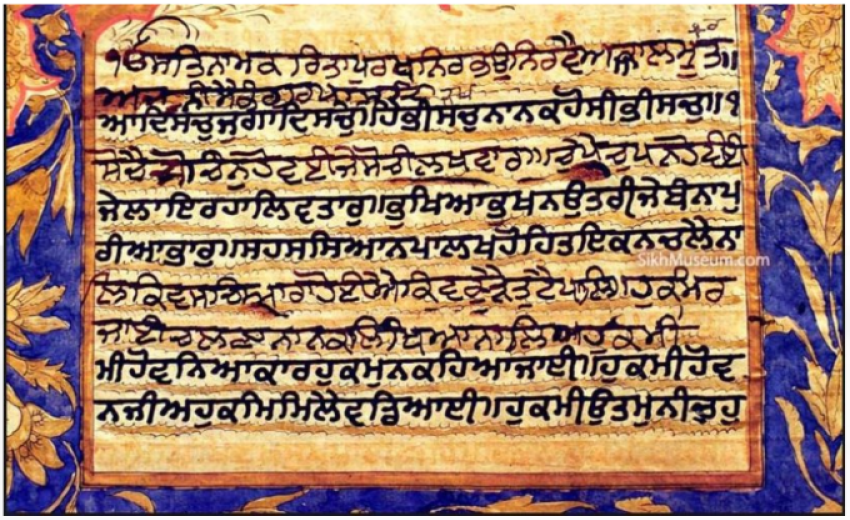
[Therefore] repeat meditatively (Jap): [He was] True in the Beginning (Aad Sach). True through the ages (Jugaad Sach), and is True now (Hai bhi Sach). Nanak says, He shall ever be True (Nanak hosi bhi Sach).
The Tenth Guru, Gobind Singh further described the Source as Unlimited Self Aware Energy (Anbhav Parkaash Amtoj).
Three pillars of Sikh religious institutions developed from Guru Nanak’s teaching: be constantly aware of the Creator Being22 (Naam japo); earn livelihood by honest means (kirat karo); and, share with those in need without distinction (wand shako).
1.4 Progress of Sikh ideology and institutions – an overview
The Sikh belief is that the Guru Light (Jyot) came from the Creator Being and passed through ten human forms starting with Guru Nanak, and now resides in the Sikh Holy Scripture, Sri Guru Granth Sahib. The Guru, therefore is a singular concept in Sikhism and refers ultimately to the Wondrous Guiding Light, the Waheguru, the Source of all creation.
A more detailed but pointed description of Sikh ideology and institutions is given in Part II.
The following table shows how the Sikh religion founded by Guru Nanak (1469-1539), evolved over a period of two hundred years under the stewardship of nine other Gurus; and how each Guru contributed to the setting up of the Sikh institutions based on Guru Nanak’s founding ideology.
Guru person/ Born/ Guru period/ Contribution)
Guru Nanak Dev 1469 (1469-1539) Founder of Sikh religion
Guru Angad Dev 1504 (1539 - 1552) Transcaste institutions; education; physical fitness
Guru Amardas 1479 (1552 – 1574) Sikh centre; organisation; position of women; sewa (Sikh institution of service).
Guru Ramdaas 1534 (1574 – 1581) Amritsar as Sikh centre; active family life.
Guru Arjan Dev 1563 (1581 – 1606) Aad Granth (Sikh holy Scripture, later bestowed Guruship as Word
Guru, Granth Sahib); institution of Darbar Sahib (Golden Temple); led Sikh martyrdom (shaheedi) tradition.
Guru Hargobind 1595 (1606 – 1644) Strengthened twin track temporal and spiritiual institutions (miri/ piri aspects of Sikh life; fearless disposition; armed defence as a last resort.
Guru Har Rai 1630 (1644 – 1661 Compassion and service from a position of strength; welfare and medical services.
Guru Har Krishan 1656 (1661 – 1664) Service; purity.
Guru Tegh Bahadur 1621 (1664 – 1675) Inner detachment; sacrifice; “fear not/frighten not” disposition
Guru Gobind Singh 1666 (1675 – 1708) Rising spirit (Chardi kala); unyielding courage in the face of impossible odds (“Sawa laakh se ik laraon”); full realisation of Guru Nanak’s vision of a transcaste theo-social order, the Khalsa Panth; return of spiritual Guruship to Sri Guru Granth Sahib, the Sikh Scriptures, and the physical personality of the Guru to the collective body of the Khalsa Panth.
Sri Guru Granth Sahib, the holy Sikh Scripture, is the Eternal Guru of the Sikhs and is the embodiment of Sikh teachings (see 1.8 below).
The Sikhs of Guru Nanak were now a theo-political nation, spearheaded by the Order of the Khalsa (Khalsa Panth). The Guru’s Khalsa are the Sikhs who have taken Amrit (undergone formal ceremony of initiation) and taken the vows to abide by the physical and spiritual way of life prescribed in the Sikh Reht Maryda (Sikh Code – see 1.9 below). The physical discipline includes the Five Kakaars (the Five “K” – see 1.10 below) and the Sikh turban, These are the gifts of the Guru to his beloved Khalsa. The Khalsa is in the Guru’s Own Image and represents the physical form of the Guru.
1.5 Main features of Sikhism23 :
* God-loving monotheism
* No brokerage between God and creation
* Direct access to the scriptures written in the popular language
* Freedom from fear through victory over self
* Spiritual / temporal balance
* Rejection of monasticism; stress on family life and community obligations
* Demolition of every traditional excuse used to perpetuate gender bias **
* Rejection of all types of discrimination
* Three pillars of Sikhi: prayer, honest work, and sharing (including social service & activism - seva)
* Cultivation of the art of eternal optimism (chardhi kalaa).
* The ultimate goal of religion is to unite humanity and the individual in a harmonious relationship with the Creator Being. That goal is achievable in this life.
1.6 Sikh temporal and spiritual (miri-piri) doctrine of double sovereignty24
* Primary allegiance to truth
* Oppose any authoritarian regime.
* State must accept own limitation of power.
“Miri-Piri is indeed a pervasive concept in Sikhism. The sword symbolizes the indivisibility of miri and piri, that of saintliness and worldliness since it establishes and protects a just order but also attacks an unjust one.” (Dr Joyce Pettigrew)25.
1.7 Sri Akal Takht Sahib: Seat of Sikh temporal authority
The highest seat of Sikh temporal authority is Sri Akal Takht Sahib facing the Harmandar Sahib (also known as the Golden Temple), at Amritsar in Punjab. As empowered by the Tenth Guru, Gobind Singh, temporal decisions are guided by the teachings of Sri Guru Granth Sahib. The procedure for arriving at these decisions (called Gurmatas) is laid down so that they are seen to be the collective decisions of the Khalsa Panth. Sri Akal Takht Sahib is symbolic of the temporal-spiritual (miri-piri) sovereignty of the Khalsa Panth.
The Sikh religion emerged as a complete system with own ideology, institutions and identity by 1699 CE:
- in the form of Khalsa Panth (pragteo Khalsa), the Order of the Khalsa, meaning both, the “pure” and those directly linked to the Guru;
- a nation of saint-soldiers;
- vested with temporal authority;
- directed to look at their sacred literature, the Guru Granth Sahib for guidance;
- provided with ideals and identity to build their national character.
Truly “A religion of the people, by the people, for the people”26.
1.8 Sikh Holy Scripture, Sri Guru Granth Sahib teaches27:
• There is one God, common to all creation, not a Jewish, Christian, Muslim, Hindu, or Sikh God etc. Such a partisan god is a lesser god not worthy of worship.
• God is known by myriad names. God has no gender, form, colour, caste, race or nationality. Any descriptions of God remain incomplete; any images of God are false. Gender and racial equality lie at the core of Sikh teaching.
• Guru Granth Sahib teaches that truth is high, higher yet is truthful living. Cultivate such a lifestyle.
• Guru Granth Sahib asks that we do not view human existence as a fall from grace but a unique opportunity to discover the divinity that is common to us and is inherent in us all.
• The ultimate reality is not to be found in the life of the ascetic, on the mountaintop, in the jungle or by renouncing the world. It is to be discovered in the family life within the contradictions of our daily existence. God is to be found in a productive family life dedicated to honest earning and service to mankind, lived in an awareness of the Infinite within us all.
• Ego, avarice, greed, lust and pride constitute the five great vices that destroy us from within and that must be harnessed to a productive, honest life.
• Guru Granth Sahib recommends a lifestyle of modest consumption, no food taboos and a prohibition of mood or mind-altering drugs and intoxicants.
• Guru Granth Sahib asks that we learn to recognize and celebrate the different beat of the distant drummer to which many of us choose to march. Our lives should, therefore, rejoice in the cultural, racial and religious diversity of mankind.
Sri Guru Granth Sahib, the Word Guru, is not an idol to be worshipped but to be read, contemplated and its divine principles enshrined in our hearts and lives as guiding precepts.
1.9 The Code of Conduct and Conventions – Sikh Reht Maryada:
The Sikh Reht Maryada (SRM) is based on the teachings of Sri Guru Granth Sahib and regulates religious and organizational aspects of Sikh life.
It can be read in full at the following links:
http://www.sikhmissionarysociety.org/sms/smspublications/rehatmaryada/
http://www.sgpc.net/sikhism/sikh-dharma-manual.asp
1.10 Sikh articles of faith – the Five “K”s
Kesh: Unshorn hair [and dastar, the Sikh turban, worn by men and optional for women, who otherwise, cover their heads with a special head-cloth – the dupatta].
Kara: Steel bracelet: signifies Guru/Sikh bond.
Kangha: Wooden comb: Tidy hair.
Kachhehra: Pair of agile shorts.
Kirpaan: Sword of adulthood, the “giver of protection and honour”
The above five articles of Sikh faith are referred to as the Five “K” s because the first letter of each article name in Punjabi, starts with letter “k”. The Sikh turban (dastaar), the most visible article of Sikh faith, is a “sacred piece of attire for the Sikhs”28 and provides hygienic covering for unshorn hair (for men), which are combed at least twice a day with the wooden comb, the Kangha. Sikh turban, the dastaar, is of great religious spiritual and temporal significance.29
Question is sometimes asked, if only Amritdhari (Khalsa initiated) Sikhs wear the Sikh articles of faith. The answer is an emphatic “no”
Sikh children start wearing the articles of faith progressively from birth more or less in the above order years before they progress on to become Amritdhari (Khalsa initiated). However, the turban is worn to cover the hair by male children from about the age of ten to twelve or sooner. Turban is not mandatory for Sikh girls or women, although some Amritdhari women do wear them. Otherwise, they cover their heads with a headcloth called dupatta or chooni.
Most Sikhs wear the kara (iron bracelet), and many also the turban throughout their lives even though they never progress to the Amritdhari stage. These articles are as sacred for them as for Amridhari Sikhs. A Sikh girl, Sarika Singh, won a court case in Wales UK, to be allowed to wear her Kara to school even though she was not Amritdhari. Those Sikhs who do wear the Kara and/or the turban regard these as sacred as the Amritdhari Sikhs regard all the Five “K” and the turban.
Sometimes young children wear the turban with pride to the gurdwara. In fact, Sikh children wearing all the five “K”s with great pride are seen in gurdwaras and during religious processions celebrating important events in the Sikh calendar. In some Sikh families, a turban ceremony takes place. Sikh children are taught that the turban is the Guru’s very special gift. The child is now moving towards a responsible age of maturity.
The formal wearing of the Kirpaan comes with maturity and is the fifth article of faith adopted following the Amrit ceremony – ceremony of rebirth into spiritual immortality. This ceremony, called Amrit-sanchaar, is the ceremony of initiation into the Order of the Khalsa conducted by five Amritdhari Sikhs representing the first Panj Pyaras, the Five Beloved Ones of Guru Gobind Singh. Kirpaan is worn with the other articles of faith including the turban when the Amrit initiation ceremony takes place and when the great responsibility that goes with it, is fully understood by the new entrant to the Order of the Khalsa.
Therefore, only an Amritdhari Khalsa (initiated Sikh) is entitled to wear the Kirpaan and carry it with full responsibility; and none other.
“Kesh (and turban), kangha, kara, kaccha and kirpan are the five K s (called Panj kakars), gifts of Guru Gobind Singh to the Khalsa. Gifts from a loving Guru who sacrificed his parents, his four sons, his own life and all that he possessed for his beloved Khalsa….keep your distinct identity and I shall endow you with my power, he said (Jab lag rahe Khalsa niara, tab lag tej dehon mai sara). ”30
The spiritual and temporal significance of the Five “K”s has been best described by Dr Joyce Pettigrew:
“The indivisibility of the temporal and the spiritual [miri-piri] is evident with respect to all the five Sikh symbols. In the temporal world they identify one as a Sikh of Guru Gobind Singh (the Tenth and last Guru), and a member of the Panth, but they have a spiritual connotation also in that they were bequeathed by the Guru to his community.”
Other than the “Kachhehra” – Sikh shorts - which is often worn more like an underwear, the other visible articles of Sikh religion have been challenged in the West. Even in the UK, with over 200 years of Anglo-Sikh treaties, conflict and friendship, it has taken the Sikhs many court battles to win some incremental concessions. The most celebrated of these court cases was the Mandla case which went all the way to the House of Lords31.
It seems, the much praised role of the Sikhs in the two World Wars has been forgotten in the UK and in Europe.
By the Guru’s Command, the Khalsa Sikh is in the Guru’s Own Image32 and it is not within a Sikh’s discretion to give up the wearing of any of the Five “K”s including the turban (dastaar). A Sikh cannot surrender these articles of faith to some temporal authority. Western governments must understand that.
1.11 Some unique events/features of Sikhism
* According to Sikh tradition, the foundation stone of Harmandar Sahib was laid by a Muslim saint.
* Guru Ganth Sahib includes teachings of Sikh Gurus and 30 saints from diverse religious backgrounds.
* The Ninth Guru, Tegh Bahadhur gave his life in defence of another religion.
* Guru Gobind Singh was initiated into the Order of the Khalsa, by his own disciples.
* Anandpur siege (circa 1700): Bhai Ghanaya, First “Red-Cross” type of service in the battlefield without distinction between friend or foe.
Most importantly, these unique events stress the Sikh acceptance of the human race as one as per Guru Gobind Singh’s injunction33. All people are welcome to the gurdwara (Sikh place of worship and centre of Sikh community life) irrespective of their religion, colour, or creed. Gurdwaras have a community kitchen called the “Langar”, in which food is served without distinction.
1.12 Chronology of key events in Sikh history
Progress from the founding of Sikh religious institutions based on Sikh ideology, through the rise and fall of the Sikh empire in North-West India, to the present day. In 1983, the UK’s House of Lords accepted the case for Sikh ethnicity as a distinct people (see Part II below), and afforded protection under UK’s Race Relations law. Sadly, this religio-ethnic classification was further justified by the traumatic Sikh experience in India of 1984 massacres in June (in Punjab) and November (India wide); the persecution of Amritdhari Sikhs in the following years in Punjab; and persecution of Sikhs in the West to date as a visible significant minority community.
1469-1708: Ten Gurus, from Nanak Sahib to Guru Gobind Singh – Sikh religion founded by Guru Nanak Sahib. Main Sikh institutions of sangat (holy congregation), pangat (non-discriminatory community kitchen promoting human equality and sharing) & Khalsa Panth (theo-political Order of the Khalsa), consolidated and established.
1708 – 1716: Banda Singh Bahadur, Sikh general appointed by Guru Gobind Singh, establishes the first Khalsa kingdom in Punjab, paving the way for the eventual establishment of Khalsa Raj in Punjab.
1716 - 1762: Massive persecution of Sikhs in Punjab by the authoritarian local Islamic and Hindu rulers. Sikhs survived through own courage, countless martyrdoms, massive sacrifices and popular support of common people from diverse religious and ethnic backgrounds. Exceptional bravery shown by Sikh women remembered in the daily prayer of the Sikhs.
1746: Sikhs killed in large numbers in an act of revenge by Lakhpat Rai, a minister (diwan) of the Nawab of Lahore. (Carnage referred to as Chhota Ghalighara in Sikh history).
1762: The Great Holocaust (ghalughara): Ahmed Shah Abdali comes from Afghanistan and attacks the Sikhs with their families killing over 30,000 Sikh men, women and children.
1766: Ahmad Shah totally routed by the Sikhs near Lahore.
1765 and 1783: The Khalsa took over Delhi several times during this period.
1783: Khalsa flag hoisted at Red Fort Delhi on 11th March 1783 and Sardar Baghel Singh led his Khalsa troops into the Fort to be received by a submissive Mughal Emperor Shah Alam II
1799: Ranjit Singh merges individual Sikh areas North of River Sutlej. Together with the Sikh states south of River Sutlej, the Khalsa established a democratic Khalsa administration from Delhi to Peshawar and from the plains of Sindh to Karakoram mountains in the North.
1809: Bilateral treaties between Britain and the Sikh theo-political nation.
1845-1849 Anglo-Sikh wars 1845-1849 resulting in the annexation of Panjab
by the British in 1849 following bitter battles between the Khalsa and the combined forces of the British and Indian states (Muslim poet described these battles as Jang Hind-Panjab i.e. battle between India and Punjab.).
1846: First British Sikh regiments raised in 1846, and many more after the collapse of the Indian Mutiny of 1857. The Sikhs helped the British to crush the Indian Mutiny uprising to prevent return to the cruel Mughal regime aided by Hindu ministers and minor Hindu princedoms. Also, the Sikhs had not forgotten the traitorous assault on Khalsa Raj by the Indians in league with the British in 1849.
1854: Maharaja Duleep Singh brought to the UK in 1854 (probably the first reluctant Sikh immigrant to the UK!). After being dispossessed of his kingdom in 1849, he was also deprived of the world famous Koh-I-Nur, the unique diamond, on arrival in England.
1897 Battle of Saragarhi on 12 September, 1897, accepted by UN as one of the most heroic in military history, in which a detachment of 22 Sikhs of 36th Sikhs fought an action against impossible odds. Their heroism was acclaimed by the British Parliament.
1914 The Sikhs enlist in large numbers during the First World War.
1919 to 1947: Sikhs spearhead the movement for the freedom of the Indian subcontinent from British rule by making over 70 % of the sacrifices according to published figures.
1939: During the Second World War, Sikhs made a massive contribution to the
war effort. During both World Wars, some 1.5 million Sikhs fought for the freedom of humankind and helped to liberate European, African, and Asian countries. 83,000 Sikhs gave their lives, whilst 110,000 were wounded. Many gallant Sikhs were awarded Victoria Crosses for their bravery.
1947: Sikhs in the Indian independence negotiations. Sikhs were promised special concessions by the Indian Union for giving up part of their homeland. Partition of the subcontinent cost the lives of estimated 500,000 Sikhs.
1950s: Sikh migration to the UK from early Nineteen-fifties.
1973: A resolution of self-determination passed to get the Sikh Nation its rights and what had been promised to the Sikhs during the independence struggle.
1983: A landmark legal decision by the House of Lords in the Mandla case: The Sikh ethnic minority status confirmed: House of Lords (Mandla v Lee (1983) [see Part II below]
1984: In June the Indian Army ordered by Prime Minister Indira Gandhi to attack historical Sikh Gurdwaras including Harmandar Sahib at Amritsar (Golden Temple complex). Foreign media journalists ordered out of Punjab in readiness for unlawful killings in Panjab by the Indian army. November 1984: Thousands of Sikhs killed in Delhi and other Indian states following the assassination of Prime Minister Indira Gandhi by her Sikh bodyguards.
Post 1984 period: Thousands of Sikhs in police custody killed in Punjab through “faked encounters”.
2002: Post 9/11 attacks on Sikhs in the US due to “mistaken identity”. Persecution of turban wearing Sikhs in the US and in Europe.
1.13 Sikh Ardaas - the supplicatory prayer
The prescribed Ardaas said individually or in congregation (sangat) in gurdwara, remembers the trials and tribulations faced and overcome by the ever victorious Khalsa, always remaining in high spirits (chardhi kalaa) and accepting God’s Will (Bhana) with equanimity. Milestone events in Sikh history and the countless Sikh martydoms (shaheedia(n)) are remembered and the Sikhs are reminded of their temporal and spiritual (miri-piri) goals for uplifting and benefiting all humanity (sarbatt da bhala). Implied in the temporal-spiritual (miri-piri) doctrine, which is the underlying theme of Ardaas, is the Sikh belief in their destination as a sovereign people. Ultimately, the Khalsa, the Army of the Timeless Being (Akal Purakh), will secure victory of a just and benevolent regime.
Historians have commented that the Sikh Ardaas has been a most powerful tool for strengthening the community’s resolve to face and overcome external threats and challenges, and for holding the global Sikh community together.
1.14 Conclusion:
There are about 25 million Sikhs living in many countries. From the above outline of Sikhism, there should be no doubt that Sikh religion is a “world religion” as defined by Mary Kochan:.
It is a “belief system of enough richness and complexity that it is capable of supporting a civilization”. It has central decision making, and research institutions empowered by the Guru – by placing authority in the Khalsa Panth as represented by Sri Akal Takht Sahib34 - to interpret Sikh ideology, to be able to “sustain people in all walks of life” and “deal with the real complexities of human relationships, absorb new ideas and discoveries, and enter into conversation with the other great human traditions.”
Part II: Sikhs as an “ethnic” group35
"While religion as belief emphasizes doctrines, religion as identity emphasizes affiliation with a group. In this sense, identity religion is experienced as something akin to family, ethnicity, race, or nationality.” 36
“The chief reason why religion becomes the focus of prejudice is that it usually stands for more than faith - it is the pivot of the cultural tradition of a group. However sublime the origins of a religion may be, it rapidly becomes secularized by taking over cultural functions.” 37
For the purpose of the UK's race relations law, "Ethnicity" has been defined by the Law Lords in the Mandla and another v Dowell Lee and another
HOUSE OF LORDS [1983]
(Quote starts)
Lord Fraser: For a group to constitute an ethnic group in the sense of the 1976 Act, it must, in my opinion, regard itself, and be regarded by others, as a distinct community by virtue of certain characteristics. Some of these characteristics are essential others are not essential but one or more of them will commonly be found and will help to distinguish the group from the surrounding community.
The conditions which appear to me to be essential are these:
[the numbering of characteristics is mine for ease of reading]
(1) a long shared history, of which the group is conscious as distinguishing it from other groups, and the memory of which it keeps alive
(2) a cultural tradition of its own, including family and social customs and manners, often but not necessarily associated with religious observance. In addition to those two essential characteristics the following characteristics are, in my opinion, relevant:
(3) either a common geographical origin, or descent from a small number of common ancestors
(4) a common language, not necessarily peculiar to the group
(5) a common literature peculiar to the group
(6) a common religion different from that of neighbouring groups or from the general community surrounding it
(7) being a minority or being an oppressed or a dominant group within a larger community, for example a conquered people (say, the inhabitants of England shortly after the Norman conquest) and their conquerors might both be ethnic groups.
A group defined by reference to enough of these characteristics would be capable of including converts, for example, persons who marry into the group, and of excluding apostates. Provided a person who joins the group feels himself or herself to be a member of it, and is accepted by other members, then he is, for the purpose of the 1976 Act, a member.
(quote ends)
The full judgement can be read at the Sikh Missionary Society UK website link:
http://www.sikhmissionarysociety.org/sms/smsarticles/legal/MandlaAndAnotherVDowellLeeAndAnother.doc
A COMMON RELIGION DIFFERENT FROM THAT OF NEIGHBOURING GROUPS IS VERY MUCH ONE OF "ETHNICITY" CHARACTERISTICS.
Even the Dutch Khalsa, Sardar Harjinder Singh (Man in Blue) has no difficulty in accepting the above legal definition of ethnicity, which is inclusive: "Provided a person who joins the group feels himself or herself to be a member of it, and is accepted by other members, then he is, for the purpose of the 1976 Act, a member."
Richardson J said (at 542):
'The real test is whether the individuals or the group regard themselves and are regarded by others in the community as having a particular historical identity in terms of their colour or their racial, national or ethnic origins. That must be based on a belief shared by members of the group.'
And the same judge said (at 543):
'. . . a group is identifiable in terms of its ethnic origins if it is a segment of the population distinguished from others by a sufficient combination of shared customs, beliefs, traditions and characteristics derived from a common or presumed common past, even if not drawn from what in biological terms is a common racial stock. It is that combination which gives them an historically determined social identity in their own eyes and in the eyes of those outside the group, they have a distinct social identity based not simply on group cohesion and solidarity but also on their belief as to their historical antecedents.'
My article at the following link is relevant:
http://emgonline.co.uk/news.php?news=4833
PART III Challenges to Sikh Identity in the West
Sikhs have a proven track record for being honest and hardworking, law-abiding and loyal citizens of the countries they live in. However, Sikh history shows that as a theo-political people, due to the temporal-spiritual (miri-piri) twin track approach to life, they have also clashed with unjust regimes.
The point has been made by Sikhs in the West that their visible Guru-given Sikh identity is not theirs to surrender to any secular regime.
For the first time, in a well researched paper, Ms Neha Singh Gohil and Dawinder Singh Sidhu, have focused on the “tangible” and “intellectual” (policy) challenges to the Sikh turban and visible articles of Sikh faith. Their paper is about the direct and indirect challenges in America to visible Sikh identity, and focuses mainly on the Sikh turban. However, it also highlights with great clarity, the general nature of religious persecution of the Sikhs in the West.
“The turban has transformed from a sacred piece of attire for Sikhs to a target for discriminatory conduct and an object of marginalization after 9/11.”38
“This largely European debate concerning the proper balance between multiculturalism and integration has necessarily placed visible articles of faith, including the Sikh turban, under intense scrutiny…..” 39
Tangible attacks are in public places “Because non-Sikhs tend to associate Sikhs’ turbans with Osama bin Laden, Sikhs with turbans have become a superficial and accessible proxy for the perpetrators of the 9/11 attacks. As a result, turbaned Sikhs in America have been victims of racial violence and have had their identity challenged by calls for immigrant groups to assimilate into Western societies.” 40
As victims, Sikhs are in the forefront of this shameful persecution.
Turbaned Sikhs (including Amritdhari Sikhs) are harassed at European and American airports due to ritualistic searches and terrorist profiling; they are barred from going to certain buildings, functions and places; they are either barred from or disadvantaged through employment preferences in certain types of employment in public and private sectors such as police and defence services; they are less likely to be selected for senior public appointments or as candidates by main political parties; turban ban in Europe has made the European concept of mobility of labour a bit of a joke for the turban wearing Sikhs; ostensibly “neutral” laws - but highly discriminatory for the Sikhs – are passed without consultation with grassroots Sikh representatives; even consultation, if any, is divisive for the Sikhs in that there are establishment preferences for dealing with certain members of the community only, who are close to the civil servants; and, turban wearing Sikhs remain almost invisible for media coverage. This list is not exhaustive.
However, because Sikh have been denied own category for monitoring statistics, the onus of producing proof of discrimination and persecution is placed on them! Sadly for the Sikhs, going by the number of court cases so far, there is no shortage of such evidence. Gohil and Sidhu paper (ibid) records numerous cases and sources supplying ample evidence that the visible identity Sikhs are facing widespread physical threat and, direct and indirect challenges to their religious freedom.
By excluding turban wearing Sikh children from schools, children are being denied the opportunity to respect and celebrate diversity.
Assault on distinct Sikh identity at state policy level – “intellectual” challenge according to Gohil and Sidhu - is now quite open. The policy of national unity which accepts diversity, has been put in reverse gear in the last few years.
Sikhs have always responded in a spirit of full co-operation with the authorities when genuine security and safety aspects of Sikh visible identity have been discussed. They have suggested ways of reducing harassment and embarrassment to turban wearing Sikhs, but appear to be fighting a losing battle in the West.
There is “a broader attack on their identity, leading them to question whether and to what extent their faith is compatible with Western society. In several democratic nations, conspicuous religious clothing, especially the Muslim veil, are considered marks of separation and demonstrative proof of a stubborn refusal to assimilate into mainstream society. This largely European debate concerning the proper balance between multiculturalism and integration has necessarily placed visible articles of faith, including the Sikh turban, under intense scrutiny in the United States as well.” 41
The right to own identity is a fundamental human right recognized by UN conventions and instruments and in international law42. The right to own identity is one’s birth-right. The right to be different is enshrined in nature!
Yet, the xenophobia of majority communities in the West, is now fueled by “neutral laws” of states, led by France against those who stand out, and look different. The French have been described as being almost “schizophrenic” about religion!
Conclusion:
This paper is a collation of useful relevant material for briefing purpose, to show that:
1. Sikhism has all the characteristics associated with a “world religion”. Sikh religion unites and guides one human race (manas ki jaat), before One Creator of all.
2. Sikh ideology and temporal-spiritual (miri-piri) institutions and distinct Sikh identity, tradition, language and culture, have progressed through a most eventful Sikh history to give the Sikhs the characteristics of a religio-ethnic people. Twice in Sikh history they established own kingdom in a large part of the northern Indian subcontinent. Sikh nationhood is a natural consequence of the unfolding of Sikh ideology and evolution of Sikh institutions. T Jeremy Gunn (ibid) has recognized such progress in world religions, which bring together temporal and spiritual (miri-piri) aspects of life. Today, Sikhs may not be a geographical nation but they have national characteristics and aspirations. In the Mandla case, the House of Lords afforded protection to Sikhs under the Race Relations law as an ethnic group; the same sort of protection afforded to other ethnic groups and nationalities.
3. There is ample evidence, especially after 9/11 that religious and “ethnic” persecution of Sikhs in the West is on the increase. This paper argues that the visible Sikh articles of faith and the turban, are the sacred gifts of the Guru, and that it is not within the discretion of an Amritdhari (Khalsa initiated) Sikh to surrender these to some secular authority. Otherwise, Sikh representatives continue to work co-operatively with security and other agencies to ensure a reasonable balance between safety and security, and Sikh religious imperatives.
4. Overt religious persecution of Sikhs in the West due to state policy (“intellectual” challenge) of assimilation is having the opposite effect to that intended. Such coercion and public harassment through e.g. profiling and meaningless ritualistic turban searches at airports and, led by France, banning of turbans in schools in Europe, will either alienate, especially young Sikhs born and brought up in Western countries, or drive them away from the responsible discipline of their religion, much to the concern of the older generation Sikhs.
Need for Sikh legal defence fund
The most urgent need for Sikhs in the West, is to set up a Sikh legal defence fund so that cases of harassment and persecution can be taken up before the law courts and, ultimately, to the United Nations. We have to learn from the experience of Sikh legal defence organizations. Complaints of religious persecution need to be taken up against organizations in the private sector, and against local government, departments and government agencies, and, as a last resort, against national governments.
Gurdwaras and every Sikh householder, who care for the future of Sikh religious identity, should be expected to contribute a regular amount to such a fund. Umbrella Sikh bodies like the Sikh Council UK, now working closely with European Sikh organizations following the Paris Sikh Summit on 26 November, 2011, can set up a vetting procedures for approving cases to be funded from this community source.
No matter what policy advice Western governments are receiving behind the scenes, Sikhs have no option but to continue fighting for their right to own religious identity. Overt state persecution should continue to be challenged robustly under the freedoms enshrined in the UN conventions and instruments.
---------------------------------
In addition to acknowledged sources, this paper is based mainly on own published material including SEWA and a number of Sikh centenary souvenir publications produced by the author. The paper was collated in consultation with Baldev Singh Dhaliwal JP of Adelaide, who also edited the final draft.
Gurmukh Singh
Sikh Education Welfare & Advancement (SEWA) Network
E-mail: sewauk2005@yahoo.co.uk
http://www.sewauk.blogspot.com/
© Copyright Gurmukh Singh
Articles may be published or quoted from, with acknowledgement
About the author:
Ret’d Principal (policy) UK Civil Service
Adviser to UK Sikh organisations since retirement from UK Civil Service in June 1996.
Senior Civil Service appointments :
Senior Personnel & Training Manager, National Economic Development Office, (1980-85);
International Trade Policy (Tariff Harmonised System), Europe 1985-87;
Departmental (Parliamentary) Vote Manager (1987-91);
Aerospace civil research funding policy (UK/Europe) 1991-June 1996
Community work since retirement.
------------------------------------------------------------------------------------------------------
Notes & reference sources:
1. Neha Singh Gohil & Dawinder Singh Sidhu, The Sikh Turban: Post 911 Challenges to This Article of Faith, p.2 RUTGERS JOURNAL OF LAW AND RELIGION
http://www0.hku.hk/sociodep/bbf/BBF%20Readings%20W10/W10%20TheSikhTurban.pdf
2. Khalsa status is attained with maturity, when a Sikh is prepared to accept and practise the discipline of the Sikh Code of Conduct (the Sikh Reht Maryada). All Sikhs are progressing towards the Khalsa stage of physical and spiritual disciplines. Literally, Khalsa means both, the pure, and the Sikh devotee directly linked spiritually to the Guru and is in the Guru’s image. Khalsa (singular or plural usage) accepts the Five articles of faith (including the Sikh turban) – the Five “K” –see part 1.6 below - as precious gifts of the Guru with which he or she must not part. Thus, he or she joins the Order of the Khalsa, the Khalsa Panth. Depending upon the context, “Khalsa Panth” also loosely refers to all the Sikhs, or the Sikh nation.
3. Quoted by Gohil & Sidhu ibid p. 60
4. Ibid p. 42
5. Ibid p.1 footnote 4
6. T. Jeremy Gunn, The Complexity of Religion and the Definition of “Religion” in International Law, p.200 Harvard Human Rights Journal / Vol. 16 pp. 214,215
[T. Jeremy Gunn: Member, OSCE/ODIHR Advisory Panel of Experts on Freedom of Religion or Belief; Senior Fellow for Religion and Human Rights, Emory University
An earlier version of this Article was commissioned by the Office of the United Nations High Commissioner for Refugees for the Roundtable on Religion-Based Refugee Claims, October 30–31, 2002, Baltimore, Maryland, sponsored by the Office of the United Nations High Commissioner for Refugees and Church World Service. That paper was prepared in conjunction with Karen Musalo, Claims for Protection Based on Religion or Belief: Analysis and Proposed Conclusions (2002).]
http://www.law.harvard.edu/students/orgs/hrj/iss16/gunn.pdf
7. Ibid p. 204
8. Gohil & Sidhu, Ibid, pp 3,4
9. Gunn Ibid p.200
10. “Religion” derived from latin religio-onis or religare – obligation, bond, reverence. System of faith and worship. To bind or bring closer . “In a similar sense, the Sikh Gurus used the word Dharam or Panth”. “O Nanak, the True Guru is One who unites all” (Sikh Holy Scripture, Sri Guru Granth Sahib p.72)
11. Gunn Ibid p.190
12. Gunn Ibid p189
13. Gunn Ibid p. 191
14. Mary Kochan, What Makes a Religion World Class? Cults, Movements, World Religions http://catholiceducation.org/articles/apologetics/ap0136.html
15. G S Sidhu & Gurmukh Singh, Sikh Religion and Islam published by some Gurdwaras and organisations and also available on link: http://www.sikhmissionarysociety.org/sms/smspublications/
See under “Additional Publications” “Multifaith”
16. Arnold J Toynbee in his Foreword to Sacred Writings of the Sikhs—A Unesco Publication
17. Pearl S. Buck Noble Laureate, ‘Good Earth’ while giving her comments on the English translation of the Guru Granth Sahib (From the foreword to the English translation of Guru Granth Sahib by Gopal Singh Dardi)
18. Bhai Gurdas II, a cotemporary of Tenth Guru, Gobind Singh., Vaara(n) Bhai Gurdas Pauri 16 line 19.
19. Daljeet Singh, The Sikh World View published by Institute of Sikh Studies, Chandigrah, India.
20. Guru Nanak’s Japji Sahib 34th Pauri (Stanza)
21. Evolved from Sikh teachings enshrined in the Sikh Scripture, Guru Granth Sahib as interpreted by the Order of the Khalsa, the Khalsa Panth, and now embodied in the Sikh Reht Maryada (Sikh Code of Conduct) http://www.sgpc.net/sikhism/sikh-dharma-manual.asp
22. The Creator has many Names and ALL names of things and beings created ( in which He resides) are His. Therefore Name or Naam is simply the Sikh way of referring to the unity of the Creator and created.
23. Based mainly on Dr I J Singh’s writings published by The Centennial Foundation, Canada.
24. Sirdar Kapur Singh “Theo-political Status of Golden Temple”, article in The Sikh Review.
25. Pettigrew Ibid p. 3
26. Dr I J Singh, Sikhs and Sikhism – A view with a bias, p xvii The Centennial Foundation, Canada.
27. Pointed summary based mainly on Dr I J Singh’s writings.
28. Gohil & Sidhu ibid p. 2
29. Gohil & Sidhu ibid p 12 about the significance of the Sikh turban under “B. Significance and Physical Aspects of the Sikh Turban”
30. Gurmukh Singh, Vaisakhi 1699: The High Point of Sikh Tradition p.19
http://www.sikhmissionarysociety.org/sms/smspublications/Vaisakhi1699GurmukhSinghSEWAUK.pdf
31. Mandla and another v Dowell Lee and another
HOUSE OF LORDS [1983] 2 AC 548, [1983] 1 All ER 1062, [1983] 2 WLR 620, [1983] IC R 385, [1983] IRLR 209, (46 MLR 759, 100 LQR 120, [1984] CLJ 219)
HEARING-DATES: 28 FEBRUARY, 1, 2, 24 MARCH 1983
32. “Khalsa Mero roop hai khaas…” – Guru Gobind Singh.
33. “Manas ki jaat sabhai ekai pehchaanbo.” Guru Gobind Singh
34. The acknowledged highest seat of Sikh temporal-spiritual (miri-piri) authority.
35. Mandla and another v Dowell Lee and another
36. Gunn Ibid p.201
37. Gunn Ibid p.203
38. Gohil & Sidhu opening paragraph.
39. Ibid Introduction p.1
40. Ibid opening paragraph
41. Ibid p.1
42. Collated in at least two relevant UK booklets not available as I complete this article. One is a booklet by the Sikh Human Rights Group and the other is the Sikh right to self-determinationas a people, prepared by lawyer Ranjit Singh, which was released in the UK Parliament a few years ago, and to which a number of UK organisations subscribed.
Sunday, 15 January 2012
Sunday, 25 December 2011
Sikh Message for 2012
(Contributed to Sikh Council UK draft message)
2011 has been one of the most eventful years in recent history. The world population now exceeds 7 billion. We face global economic crisis while natural and man-made disasters have taken their toll. Tyrannical regimes have tumbled and the most wanted terrorist in the world, Osama bin Laden, has been killed.
We watched helplessly, as the summer madness swept across English cities and shops and businesses were looted and set on fire.
The Sikh Council UK agrees with the Prime Minister David Cameron when he warned us following the summer riots, that these unprecedented events were “a wake up call for the country.” Indeed, it was also a wake up call for all religious communities in the UK to work together to meet the challenges of diversity in human society, and to unite by sharing human values preached by all religions..
The economic and environmental challenges which the ever shrinking global village continues to face, seem almost unsurmountable. Yet these challenges can also be a spur to finding solutions for the survival of the humankind.
Sikh thought stresses, “Where God exists there is no selfishness, where self exists there is no God.” There is need for balance between material ambition and spiritual well-being. Community involvement is necessary for the creation of a just and peaceful society. Every person needs to work for peace; especially those who lead communities, and those who are in positions of power and authority.
To the religious zealot, the Sikh message is clear: God is everywhere and in everyone; no religion is superior to another. No matter which religious path one follows, all will miss their final religious objective without truthful conduct and good deeds. There is no place for terrorism in true religion; nor for those who incite hatred against other religions.
It is futile to seek converts to own religion by condemning others and fighting wars in the name of religion. True religion should seek converts to peace and contentment while respecting the rights of others.
In connection with religious freedom, Britain has led the world in respecting the rights of people from many diverse religious backgrounds. Sikhs are proud of their “British” identity. Sikhs are also proud of their distinct Sikh identity which is associated with their outstanding military service in Europe during the two World Wars.
The Sikh Council UK looks forward to working with the British government in 2012, to persuade EU countries to fully accept Sikh identity as an important religious right.
Today we see the results of selfish pursuit of power and wealth, and irresponsible consumerism. There is much human poverty and suffering while the rich get richer. Guru Nanak’s universal message to humankind is highly relevant: to live a life of service, a life of sharing with others, and belief in equality of humankind before One Creator of all.
Sikhs invite people of all beliefs to do something about the environment to save “Great Mother Earth” (Mata Dharat Mahat).
How the human race rises to the challenges ahead, will shape the world in the years to come.
Gurmukh Singh
E-mail sewauk2005@yahoo.co.uk
© Copyright Gurmukh Singh
Articles may be published with acknowledgement
2011 has been one of the most eventful years in recent history. The world population now exceeds 7 billion. We face global economic crisis while natural and man-made disasters have taken their toll. Tyrannical regimes have tumbled and the most wanted terrorist in the world, Osama bin Laden, has been killed.
We watched helplessly, as the summer madness swept across English cities and shops and businesses were looted and set on fire.
The Sikh Council UK agrees with the Prime Minister David Cameron when he warned us following the summer riots, that these unprecedented events were “a wake up call for the country.” Indeed, it was also a wake up call for all religious communities in the UK to work together to meet the challenges of diversity in human society, and to unite by sharing human values preached by all religions..
The economic and environmental challenges which the ever shrinking global village continues to face, seem almost unsurmountable. Yet these challenges can also be a spur to finding solutions for the survival of the humankind.
Sikh thought stresses, “Where God exists there is no selfishness, where self exists there is no God.” There is need for balance between material ambition and spiritual well-being. Community involvement is necessary for the creation of a just and peaceful society. Every person needs to work for peace; especially those who lead communities, and those who are in positions of power and authority.
To the religious zealot, the Sikh message is clear: God is everywhere and in everyone; no religion is superior to another. No matter which religious path one follows, all will miss their final religious objective without truthful conduct and good deeds. There is no place for terrorism in true religion; nor for those who incite hatred against other religions.
It is futile to seek converts to own religion by condemning others and fighting wars in the name of religion. True religion should seek converts to peace and contentment while respecting the rights of others.
In connection with religious freedom, Britain has led the world in respecting the rights of people from many diverse religious backgrounds. Sikhs are proud of their “British” identity. Sikhs are also proud of their distinct Sikh identity which is associated with their outstanding military service in Europe during the two World Wars.
The Sikh Council UK looks forward to working with the British government in 2012, to persuade EU countries to fully accept Sikh identity as an important religious right.
Today we see the results of selfish pursuit of power and wealth, and irresponsible consumerism. There is much human poverty and suffering while the rich get richer. Guru Nanak’s universal message to humankind is highly relevant: to live a life of service, a life of sharing with others, and belief in equality of humankind before One Creator of all.
Sikhs invite people of all beliefs to do something about the environment to save “Great Mother Earth” (Mata Dharat Mahat).
How the human race rises to the challenges ahead, will shape the world in the years to come.
Gurmukh Singh
E-mail sewauk2005@yahoo.co.uk
© Copyright Gurmukh Singh
Articles may be published with acknowledgement
Friday, 23 December 2011
Dya Singh of Australia at Jalandhar, Punjab.
Flanked by a “taoos” playing maestro on one side, and a Guiness record holder, tabla player, on the other, it was an unlikely setting at Jalandhar in central Punjab, for world renowned Dya Singh of Australia. For the first time, he was finding himself at a Kirtan smagam, without his motley group of musicians playing a range of East-West musical instrumental blends.
He enthralled the Sangat at this private programme on 1 November, 2011, with classical reets (tunes) reminiscent of great classical ragis like late Bhai Avatar Singh.
Dya Singh had stopped at Delhi for a couple of days on his way to the family home at Ludhiana in Punjab. He was invited by a jatha of Gursikh shardhalus (devotees) to join them on their monthly trip for Sangrand darshan of Darbar Sahib (Golden Temple, Amritsar) on specially booked coaches on the Shtabdi train. The condition for this free ride was simple. “Please do Kirtan taking your turn with other raagi jathas while travelling with us”, That was the request of the organiser. Dya Singh’s host at Delhi agreed readily before he could say a word!
And so it was “Charan chalo marag Gobind.” (With your feet walk the Lord’s path) sung by the whole jatha in three coaches linked by CCTV system. The waves of the divine Sangat Kirtan led by Dya Singh, floated across the farmlands of Haryana and Panjab as the train covered miles of countryside. However, before he reached Ludhiana he had been “persuaded” (Khalsa style) to do a special Kirtan programme for Kirtan devotees at Jalandhar.
He was alone during this Punjab trip, and, so far he is concerned, a stranger in his own country of origin. (He was born in Malaysia.)
And so, Paramjot Singh, who rose to fame by getting his name into the Guiness Book of records for playing tabla continuously for 113 hours, 13 minutes and 13 seconds, and musical teacher specialising in taoos, Sri Pal Singh, came to the rescue. I had covered Paramjot’s record breaking tabla playing story in my UK columns and he is a regular visitor at home in Ludhiana.
Dya Singh mentioned in the introduction, that the “taoos” played by Sri Pal Singh, is a string instrument (like Indian sarangi, only deeper and more melodious), which was made popular by Guru Hargobind Sahib.
So, on 1st November, 2011, the trio found themselves together at Jalandhar Kirtan society’s programme. The deep sound of the taoos filled the environment as the mixed Sangat (Sikhs and, apparently, non-Sikhs) – all Kirtan lovers – listened in deep meditation. Dya Singh’s heart-piercing rendition of Shabad refrain, “Hao reh na saka(n) bin dekhay mery maaee” (I cannot live without the holy sight of my Beloved, O my mother) touched all hearts. I was particularly moved by the classical notes of the taoos and Sri Pal Singh’s soft vocal accompaniment.
Madhwanti Kalyan captured the evening mood. A Shabad, Eh doay naina matt shoho Pir dekhan ki aas” (Touch not these two eyes (a plea to the crows) for I still have hope to see my Beloved Lord) by Bhagat Farid, was a request from an elderly Sikh who came up to the stage.
Paramjot Singh accompanied with sympathetic taal (beat) variety, enhancing the Shabad impact, and excelled in controlled tabla display. During such displays, he alternated effortlessly between deep sounding “mardang” type of beat from a wide-top tabla, and ordinary “kinaar”.
Fortunately the sound quality of the, otherwise amateurish video of this private Kirtan programme, is good. With professional editing this can be Dya Singh’s first successful Kirtan video. I have watched this programme several times on video and wonder, if Dya Singh, an accountant by training, could not have done better by becoming a traditional Kirtania.But then, who else could have taken the universal Message of Sarab Sanjhi Bani to mixed global audiences in Dya Singh’s unique pioneering Sikh world-music style?
Gurmukh Singh UK
E-mail: sewauk2005@yahoo.co.uk
Copyright: Gurmukh Singh
This article may be published with acknowledgement.
Thursday, 15 December 2011
Sikh Council UK & Sikh Issues
Background:
Due to the longstanding need felt by British Sikhs, the setting up of the Sikh Council UK has been widely welcomed. The Council has gained rapid recognition in government circles and is settling down to address the most important challenges we face today.
This is perhaps the right time to remind ourselves what the main issues and challenges are.
Internal divisions centred around personalities have been a major setback for Sikh unity and progress of Sikh issues. Effective communication at local and national levels in English has been the other difficulty. Without balanced presentation of Sikh problems to the government and departments in the language of the British establishment, Sikh jathebandis are unable to influence government policy.
In the past, some ambitious individuals have used the language difficulty to pursue own agendas. The influence they have on Sikh affairs has been far in excess of their knowledge of Sikh tradition or actual support at grassroots level. For example, the French Sikh turban case could have been handled much more openly and effectively from the start. However, personal ambition rather than knowledge of Sikh religious significance of dastaar, took over. In an attempt to seek exemption from French restrictions, by some clever argument, Sikh dastaar was presented as a “cultural” item instead of an essential religious requirement. Regrettably, as in other such cases, history is being re-written to gloss over such errors. In this case, other organisations were blamed for Sikh failure.
Despite some achievements, UK and European acceptance of Sikh identity has been incremental, and grudgingly conceded after much lobbying, demonstrations and legal battles. Due to lack of co-ordinated professional team-working at frontline level, progress made on the most important issues has been limited.
At individual level Sikhs are prosperous. Next generations are doing well in education and professions. However, despite being a sizeable community, Sikh identity is hardly seen in public life, politics and the Parliament. There is much ignorance about who Sikhs are. Future Sikh generations need to be proud of the “Sikh” part of their “Sikh British” identity to grow up as responsible citizens fully aware of own heritage and culture. Sense of belonging to a community is an important aspect of personal development and identity.
That sense of pride and belonging also depends on the acceptance of the community’s identity within the larger British plural society. That is one important goal for the Sikh Council UK.
Past achievements: Setting the record straight
Those who claim that they have been able to get results only through personal contacts are out of touch with ground realities. Despite exaggerated claims of individual contribution, success in the Mandla case, for example, was due to united support by the Sangat. The case reached the House of Lords and is regarded as a milestone achievement.
To set the record straight, I am content to quote S. Sewa Singh Mandla. In response to a query to clarify how the case was won, he wrote on 17 May 2010:
“A couple of years ago the Sikh Police Association London at their AGM wanted to celebrate 25th anniversary of Mandla v Lee case and had invited me to give a talk on the case and make a presentation, which I did. In my talk I said that having lost the case in the lower courts I realized that this case will affect the entire Sikh Community and as such I wanted to involve the Community in the case. With this in mind I went to Sant Baba Puran Singh Ji the Founder of Nishkam Sewak Jatha Birmingham (GNNSJ) and sought His Blessing and assistance.
It was GNNSJ who prepared information packs about Sikhism and the importance of the Turban to the Sikhs and send them out to all Members of Parliament and other important people to increase awareness and support. GNNSJ got support from all communities for this cause. It was GNNSJ which took a lead in the campaign and organized a mass rally at e Hyde Park in London . I showed the clip of the BBC Television interview with Sant Baba Puran Singh Ji, Bhai Sahib Norang Singh ji (the then Chairman of GNNSJ), Mr. Mavi of (CRE) and my self and I finally said that the case in the House of Lords was won purely with the Blessings of Sant Baba Puran Singh Ji. Now that is the truth. I know that it was GNNSJ who mobilised the entire community and in fact hired 70 coaches and send them to the Gurudwaras and other organisations who wanted to attend the rally at the Hyde Park.” (S. Sewa Singh Mandla’s e-mail of 17 May 2010)
Yet, this collective historic achievement is being re-written with a bias towards individual contribution to the ultimate success. The opportunity to build on a milestone victory for Sikh unity and identity, has been lost
The historical fact is that past achievements were due to united effort by Sikh Sangats. There are important lessons to be learnt. Ambitious activists with language and communication skills, otherwise dedicated to Panthic work, tend to take personal credit far in excess of their actual contribution. Their proximity with departmental officials gives them own following in the community. That is not in the community’s long term interest. Individuals with language skills should serve jathebandis; it is not for jathebandis to serve their personal aspirations.
Issues for the Sikh Council UK
The establishment of the Sikh Council UK gives us an opportunity to review the most important issues which concern us as a distinct religio-social community; the extent to which progress has been made and the challenges which we continue to face. These would be matters which need to be taken up by the Sikh Council and affiliated organisations, with the UK and European governments, agencies and authorities. Most other issues can be dealt with by Sikh organisations and Panthic jathebandis with experience in specific areas. Anglo-Sikh heritage, Khalsa Aid and legal representation of Sikh issues e.g. by United Sikhs, are important activities which promote Sikh identity, but need not be dealt with in the context of matters discussed under the umbrella of Sikh Council UK.
With regard to Sikh expectations from the British establishment (mainly the legislative/legal and administrative system), we would have expected full recognition of Sikhs as a distinct community in the British multicultural society after over 50 years of Sikh immigration. We are the largest single distinct minority (religio-ethnic) group in the United Kingdom, but we were not even recognized as such until 1983 (see below). Even today, that recognition has been less than forthcoming in areas such as monitoring of Sikhs as a distinct community with own religio-social identity, Sikh human rights, including religious rights and freedoms, and equal opportunities in various fields such as employment, education and representation at various levels of local and national government.
The media, which is also a part of British establishment, plays an important role in educating the public and changing set attitudes towards immigrant communities. In case of the Sikhs, it has, in fact, played quite the opposite role in creating confusion and distrust about Sikh identity. That despite the fact that the Sikhs are a hard working and law-abiding community least dependent on state benefits.
The ignorance which security agencies continue to show about Sikh identity in the UK and Europe is quite remarkable despite over 200 years of Anglo-Sikh relations.
Question of Sikh monitoring
Sikhs qualify under “ethnic”, “religious” or any other classification to be counted as a distinct community. Those who restrict Sikh counting to “religion” only, or prefer to wait for some possible future system which describes them more correctly, do not understand Sikh temporal-spiritual (miri-piri) tradition, or are just living in some unreal world while the community continues to suffer discrimination.
The Race Relations Act 1976 was meant to give equal rights to all ethnic minorities. However, the Sikhs were not protected by the Act, because they were not considered to be an ethnic group. It took seven years for the Sikhs to be given protection under the Race Relations law in 1983. In that year the House of Lords (in the case of Mandla v. Lee), ruled that the Sikhs qualified as an “ethnic” minority, albeit, by redefining “ethnicity” to some extent.
That did not please some individuals and the opportunity to be monitored under the current system as an ethnic minority was lost.
The unfortunate Sikh experience is that sometimes, personally held views are passed on as representative views of the UK Sikhs. One example in the context of the “ethnic” monitoring debate is that Sikhs are only a “religion” and not an ethnic community as defined by the House of Lords in the Mandla case. That is not a generally held view about Sikhi, which is a twin track spiritual-temporal way of life (the “miri-piri” approach).
The “ethnic” aspect is derived from an inseparable combination of many factors, which not only include an independent religious ideology but also, as one “people”, common heritage, history, language and culture. All those who become Sikhs, regardless of their previous background, automatically share these traits according to the Law Lords. Sikhi is a way of life which is now protected under the Race Relations legislation. Never mind what one’s personal views may be, that is the law of this land and Sikhs legally qualify for monitoring under any system based on “ethnicity” or “religion” or any other distinct theo-social community definition. Yet, there are some leading Sikh “lights” who continue to insist that we should continue to suffer disadvantages by not being counted and monitored unless it is on the basis of “religion” only.
UK Sikhs hope that a change in the monitoring system in future would give them the right to be monitored as a distinct community. Sikh Council UK can ensure that the collective views of the Sikhs are heard.
Government consultation preferences
Government departments prefer to consult Sikhs and, presumably, other communities, through established personal contacts only. Officials are usually reluctant to come to terms with changing circumstances and to meet new faces.
It is for Sikh organisations to present a united view when consulted by the government, departments and agencies. Communication experts should serve organisations to present that agreed view.
After the terrorist attack in America on 11th September, 2001, we also suffered due to mistaken identity, and misleading terrorist profiling of Sikhs by security agencies. Sikhs were attacked but the police did not keep figures because Sikhs are not monitored under the current system for collating statistics, despite the fact that in law (by virtue of the Mandla case 1983) Sikhs qualified under religious as well as ethnic categories.
Government consultation with the Sikhs has remained ineffective. Except for one recent selection in the Lords, visible Sikh identity is missing in the House of Commons. As a consequence, the Sikhs are hardly able to make any prior contribution to the process of law making to ensure that their religious identity and rights as a distinct community, are safeguarded. There is much frustration in the community. Either Sikhs have not been consulted before policy decisions about future legislation, or there have been misunderstandings that have led to a lack of protection of Sikh religious rights. Sometimes, the Government says that it has consulted Sikh “leaders”. We are left wondering who these Sikh representatives are, who advise the government departments.
Immediately after 11th September, 2001, without consultation, Sikhs were told not to wear the “kirpan. A Home Office Minister wrote to the Sikhs that he had been advised that Sikhs could carry small wooden or plastic “kirpans”. For practising Sikhs that was a cruel joke! Sikhs do not know to this day who gave that advice.
Before final summing up, there are some unique features of the Sikh way of life which should be noted. Compared with orthodox Semitic and eastern religious ideologies, the end purpose of Sikhi is to serve creation (as the image of the Creator) here and now. No other reward is expected or sought in some hereafter existence. This direct “here and now” activism - miri aspect of Sikhi - which has claimed countless martyrdoms, is inherent in “Raj Karega Khalsa”, “Degh, Tegh, Fateh” and “halemi raj” ideals. These are not exclusive but inclusive concepts for the wellbeing of all humanity.
Sikhi is more than a traditional “religion” due to its stress on action based life for the good of all.
Conclusion
Over 700,000 British Sikhs make up the largest religious and “ethnic” UK minority. In the last national census, Sikhs were given an optional “Religion” box to tick. However, religion is NOT used for monitoring any discrimination so that policy changes can be made to ensure a more level playing field in future. Monitoring of Sikhs under any current system is the first priority for the Sikh Council UK and affiliated organisations. Most other issues relate to this main goal which remains to be achieved.
Challenges to Sikh identity (ideological and visible) must be faced through better education of non-Sikhs including UK and European governments, authorities and security agencies. The French Dastaar issue, airport Dastaar searches, ban on wearing visible Sikh Kakaars, the Kirpaan and the Kara are the main challenges.
Fair share of visible Sikh representation in British public life is the third priority. Again this issue is relevant to the question of Sikh monitoring in different fields. Sikhs are not getting their fair share of senior appointments, awards and honours for community work. (It may be that mainstream Sikh organisations are slow to send timely nominations.)
Sikhs lack regular contacts with the mainstream national media. They should be in the news more often, projecting a positive image. Sikhs need effective media management at local and national levels. Only youngish, well educated and presentable Sikhs can do this. Older “jathedar” types must understand this and nominate and promote youngish Sikhs for such roles.
Sikh human rights area in the Indian context is a controversial but important issue. It continues to divide UK Sikhs but it must be faced, albeit, with presentational caution to ensure that British Sikhs are seen to be raising just concerns on humanitarian grounds. Like all UK citizens they have every right to do that through the Sikh Council UK and through the British government.
As mentioned at the outset, Sikh heritage including Anglo-Sikh heritage aspect, and global Sikhi seva in the field, are important for promoting Sikh identity but would be best left to voluntary organisations. Interpretation of Gurbani in the context of 21st Century issues is an ongoing need. Research by panels of UK Sikh scholars on some of these issues can be supported by organisations like the Sikh Missionary Society UK.
Ongoing discussion of priority issues and challenges which concern British Sikhs and the Sikh Council UK, is a learning process. Unhealthy official cronyism has been a divisive and damaging factor in British Sikh affairs. It is hoped that any criticism does not detract from the dedication and positive contribution of some individuals.
Diaspora Sikhs look up to British Sikhs to lead.
Gurmukh Singh UK
E-mail: sewauk2005@yahoo.co.uk
Copyright: Gurmukh Singh
Article may be published, or quoted from, with acknowledgment.
Due to the longstanding need felt by British Sikhs, the setting up of the Sikh Council UK has been widely welcomed. The Council has gained rapid recognition in government circles and is settling down to address the most important challenges we face today.
This is perhaps the right time to remind ourselves what the main issues and challenges are.
Internal divisions centred around personalities have been a major setback for Sikh unity and progress of Sikh issues. Effective communication at local and national levels in English has been the other difficulty. Without balanced presentation of Sikh problems to the government and departments in the language of the British establishment, Sikh jathebandis are unable to influence government policy.
In the past, some ambitious individuals have used the language difficulty to pursue own agendas. The influence they have on Sikh affairs has been far in excess of their knowledge of Sikh tradition or actual support at grassroots level. For example, the French Sikh turban case could have been handled much more openly and effectively from the start. However, personal ambition rather than knowledge of Sikh religious significance of dastaar, took over. In an attempt to seek exemption from French restrictions, by some clever argument, Sikh dastaar was presented as a “cultural” item instead of an essential religious requirement. Regrettably, as in other such cases, history is being re-written to gloss over such errors. In this case, other organisations were blamed for Sikh failure.
Despite some achievements, UK and European acceptance of Sikh identity has been incremental, and grudgingly conceded after much lobbying, demonstrations and legal battles. Due to lack of co-ordinated professional team-working at frontline level, progress made on the most important issues has been limited.
At individual level Sikhs are prosperous. Next generations are doing well in education and professions. However, despite being a sizeable community, Sikh identity is hardly seen in public life, politics and the Parliament. There is much ignorance about who Sikhs are. Future Sikh generations need to be proud of the “Sikh” part of their “Sikh British” identity to grow up as responsible citizens fully aware of own heritage and culture. Sense of belonging to a community is an important aspect of personal development and identity.
That sense of pride and belonging also depends on the acceptance of the community’s identity within the larger British plural society. That is one important goal for the Sikh Council UK.
Past achievements: Setting the record straight
Those who claim that they have been able to get results only through personal contacts are out of touch with ground realities. Despite exaggerated claims of individual contribution, success in the Mandla case, for example, was due to united support by the Sangat. The case reached the House of Lords and is regarded as a milestone achievement.
To set the record straight, I am content to quote S. Sewa Singh Mandla. In response to a query to clarify how the case was won, he wrote on 17 May 2010:
“A couple of years ago the Sikh Police Association London at their AGM wanted to celebrate 25th anniversary of Mandla v Lee case and had invited me to give a talk on the case and make a presentation, which I did. In my talk I said that having lost the case in the lower courts I realized that this case will affect the entire Sikh Community and as such I wanted to involve the Community in the case. With this in mind I went to Sant Baba Puran Singh Ji the Founder of Nishkam Sewak Jatha Birmingham (GNNSJ) and sought His Blessing and assistance.
It was GNNSJ who prepared information packs about Sikhism and the importance of the Turban to the Sikhs and send them out to all Members of Parliament and other important people to increase awareness and support. GNNSJ got support from all communities for this cause. It was GNNSJ which took a lead in the campaign and organized a mass rally at e Hyde Park in London . I showed the clip of the BBC Television interview with Sant Baba Puran Singh Ji, Bhai Sahib Norang Singh ji (the then Chairman of GNNSJ), Mr. Mavi of (CRE) and my self and I finally said that the case in the House of Lords was won purely with the Blessings of Sant Baba Puran Singh Ji. Now that is the truth. I know that it was GNNSJ who mobilised the entire community and in fact hired 70 coaches and send them to the Gurudwaras and other organisations who wanted to attend the rally at the Hyde Park.” (S. Sewa Singh Mandla’s e-mail of 17 May 2010)
Yet, this collective historic achievement is being re-written with a bias towards individual contribution to the ultimate success. The opportunity to build on a milestone victory for Sikh unity and identity, has been lost
The historical fact is that past achievements were due to united effort by Sikh Sangats. There are important lessons to be learnt. Ambitious activists with language and communication skills, otherwise dedicated to Panthic work, tend to take personal credit far in excess of their actual contribution. Their proximity with departmental officials gives them own following in the community. That is not in the community’s long term interest. Individuals with language skills should serve jathebandis; it is not for jathebandis to serve their personal aspirations.
Issues for the Sikh Council UK
The establishment of the Sikh Council UK gives us an opportunity to review the most important issues which concern us as a distinct religio-social community; the extent to which progress has been made and the challenges which we continue to face. These would be matters which need to be taken up by the Sikh Council and affiliated organisations, with the UK and European governments, agencies and authorities. Most other issues can be dealt with by Sikh organisations and Panthic jathebandis with experience in specific areas. Anglo-Sikh heritage, Khalsa Aid and legal representation of Sikh issues e.g. by United Sikhs, are important activities which promote Sikh identity, but need not be dealt with in the context of matters discussed under the umbrella of Sikh Council UK.
With regard to Sikh expectations from the British establishment (mainly the legislative/legal and administrative system), we would have expected full recognition of Sikhs as a distinct community in the British multicultural society after over 50 years of Sikh immigration. We are the largest single distinct minority (religio-ethnic) group in the United Kingdom, but we were not even recognized as such until 1983 (see below). Even today, that recognition has been less than forthcoming in areas such as monitoring of Sikhs as a distinct community with own religio-social identity, Sikh human rights, including religious rights and freedoms, and equal opportunities in various fields such as employment, education and representation at various levels of local and national government.
The media, which is also a part of British establishment, plays an important role in educating the public and changing set attitudes towards immigrant communities. In case of the Sikhs, it has, in fact, played quite the opposite role in creating confusion and distrust about Sikh identity. That despite the fact that the Sikhs are a hard working and law-abiding community least dependent on state benefits.
The ignorance which security agencies continue to show about Sikh identity in the UK and Europe is quite remarkable despite over 200 years of Anglo-Sikh relations.
Question of Sikh monitoring
Sikhs qualify under “ethnic”, “religious” or any other classification to be counted as a distinct community. Those who restrict Sikh counting to “religion” only, or prefer to wait for some possible future system which describes them more correctly, do not understand Sikh temporal-spiritual (miri-piri) tradition, or are just living in some unreal world while the community continues to suffer discrimination.
The Race Relations Act 1976 was meant to give equal rights to all ethnic minorities. However, the Sikhs were not protected by the Act, because they were not considered to be an ethnic group. It took seven years for the Sikhs to be given protection under the Race Relations law in 1983. In that year the House of Lords (in the case of Mandla v. Lee), ruled that the Sikhs qualified as an “ethnic” minority, albeit, by redefining “ethnicity” to some extent.
That did not please some individuals and the opportunity to be monitored under the current system as an ethnic minority was lost.
The unfortunate Sikh experience is that sometimes, personally held views are passed on as representative views of the UK Sikhs. One example in the context of the “ethnic” monitoring debate is that Sikhs are only a “religion” and not an ethnic community as defined by the House of Lords in the Mandla case. That is not a generally held view about Sikhi, which is a twin track spiritual-temporal way of life (the “miri-piri” approach).
The “ethnic” aspect is derived from an inseparable combination of many factors, which not only include an independent religious ideology but also, as one “people”, common heritage, history, language and culture. All those who become Sikhs, regardless of their previous background, automatically share these traits according to the Law Lords. Sikhi is a way of life which is now protected under the Race Relations legislation. Never mind what one’s personal views may be, that is the law of this land and Sikhs legally qualify for monitoring under any system based on “ethnicity” or “religion” or any other distinct theo-social community definition. Yet, there are some leading Sikh “lights” who continue to insist that we should continue to suffer disadvantages by not being counted and monitored unless it is on the basis of “religion” only.
UK Sikhs hope that a change in the monitoring system in future would give them the right to be monitored as a distinct community. Sikh Council UK can ensure that the collective views of the Sikhs are heard.
Government consultation preferences
Government departments prefer to consult Sikhs and, presumably, other communities, through established personal contacts only. Officials are usually reluctant to come to terms with changing circumstances and to meet new faces.
It is for Sikh organisations to present a united view when consulted by the government, departments and agencies. Communication experts should serve organisations to present that agreed view.
After the terrorist attack in America on 11th September, 2001, we also suffered due to mistaken identity, and misleading terrorist profiling of Sikhs by security agencies. Sikhs were attacked but the police did not keep figures because Sikhs are not monitored under the current system for collating statistics, despite the fact that in law (by virtue of the Mandla case 1983) Sikhs qualified under religious as well as ethnic categories.
Government consultation with the Sikhs has remained ineffective. Except for one recent selection in the Lords, visible Sikh identity is missing in the House of Commons. As a consequence, the Sikhs are hardly able to make any prior contribution to the process of law making to ensure that their religious identity and rights as a distinct community, are safeguarded. There is much frustration in the community. Either Sikhs have not been consulted before policy decisions about future legislation, or there have been misunderstandings that have led to a lack of protection of Sikh religious rights. Sometimes, the Government says that it has consulted Sikh “leaders”. We are left wondering who these Sikh representatives are, who advise the government departments.
Immediately after 11th September, 2001, without consultation, Sikhs were told not to wear the “kirpan. A Home Office Minister wrote to the Sikhs that he had been advised that Sikhs could carry small wooden or plastic “kirpans”. For practising Sikhs that was a cruel joke! Sikhs do not know to this day who gave that advice.
Before final summing up, there are some unique features of the Sikh way of life which should be noted. Compared with orthodox Semitic and eastern religious ideologies, the end purpose of Sikhi is to serve creation (as the image of the Creator) here and now. No other reward is expected or sought in some hereafter existence. This direct “here and now” activism - miri aspect of Sikhi - which has claimed countless martyrdoms, is inherent in “Raj Karega Khalsa”, “Degh, Tegh, Fateh” and “halemi raj” ideals. These are not exclusive but inclusive concepts for the wellbeing of all humanity.
Sikhi is more than a traditional “religion” due to its stress on action based life for the good of all.
Conclusion
Over 700,000 British Sikhs make up the largest religious and “ethnic” UK minority. In the last national census, Sikhs were given an optional “Religion” box to tick. However, religion is NOT used for monitoring any discrimination so that policy changes can be made to ensure a more level playing field in future. Monitoring of Sikhs under any current system is the first priority for the Sikh Council UK and affiliated organisations. Most other issues relate to this main goal which remains to be achieved.
Challenges to Sikh identity (ideological and visible) must be faced through better education of non-Sikhs including UK and European governments, authorities and security agencies. The French Dastaar issue, airport Dastaar searches, ban on wearing visible Sikh Kakaars, the Kirpaan and the Kara are the main challenges.
Fair share of visible Sikh representation in British public life is the third priority. Again this issue is relevant to the question of Sikh monitoring in different fields. Sikhs are not getting their fair share of senior appointments, awards and honours for community work. (It may be that mainstream Sikh organisations are slow to send timely nominations.)
Sikhs lack regular contacts with the mainstream national media. They should be in the news more often, projecting a positive image. Sikhs need effective media management at local and national levels. Only youngish, well educated and presentable Sikhs can do this. Older “jathedar” types must understand this and nominate and promote youngish Sikhs for such roles.
Sikh human rights area in the Indian context is a controversial but important issue. It continues to divide UK Sikhs but it must be faced, albeit, with presentational caution to ensure that British Sikhs are seen to be raising just concerns on humanitarian grounds. Like all UK citizens they have every right to do that through the Sikh Council UK and through the British government.
As mentioned at the outset, Sikh heritage including Anglo-Sikh heritage aspect, and global Sikhi seva in the field, are important for promoting Sikh identity but would be best left to voluntary organisations. Interpretation of Gurbani in the context of 21st Century issues is an ongoing need. Research by panels of UK Sikh scholars on some of these issues can be supported by organisations like the Sikh Missionary Society UK.
Ongoing discussion of priority issues and challenges which concern British Sikhs and the Sikh Council UK, is a learning process. Unhealthy official cronyism has been a divisive and damaging factor in British Sikh affairs. It is hoped that any criticism does not detract from the dedication and positive contribution of some individuals.
Diaspora Sikhs look up to British Sikhs to lead.
Gurmukh Singh UK
E-mail: sewauk2005@yahoo.co.uk
Copyright: Gurmukh Singh
Article may be published, or quoted from, with acknowledgment.
Tuesday, 13 December 2011
Sikh-Muslim Similarities & Question of Mistaken Identity
In the first week of December 2011, a Sikh preacher was stabbed by a 26-years old American at Fresno airport. Most probably, he was attacked because he looked like the turban-wearing bearded Islamic jihadis (religious warriors) who are fighting the Americans at places like Afghanistan. Bodies of dead American soldiers are arriving daily from that part of the world.
As other similar assaults on turban wearing Sikhs since 9/11, this life threatening attack too was probably due to mistaken identity.
A turban wearing bearded person is seen as a threat to security, even by ignorant or misguided officials in Western countries. Practising Sikhs are put on the defensive while real terrorists get away, literally, with murder !
At about the same time as the Fresno airport attack on the UK based Sikh preacher, a heated debate was going on under the heading, “Seeking Sikh Muslim Peace” on a cyber forum, Gurmat Learning Zone (GLZ). I started taking an interest when a Sikh writer, Nanak Singh Nishter, introduced his paper to the debate. He wrote, “To add further, following is my paper "Similarities between Muslims and Sikhs" to be submitted at a scheduled international seminar on "Islamic Culture & Art" being organised by the Maulana Azad National Urdu University at Hyderabad.”
In this paper, he writes, “There are seven Muslim co-authors of Shri Guru Granth Sahib.”
To describe the galaxy of bhagats honoured in Guru Granth Sahib, as co-authors of Guru Granth Sahib, is misleading. We also need to bear in mind that these saints associated with the God-loving bhagti movement, which preached One Divine Light in all, were socio-religious reformers of their time. They were often punished for their egalitarian teachings by the orthodox religions they were associated with by their birth. It may even be argued that they had opted out of the dogma based divisive ideologies of the orthodox religions.
It is necessary to quote one part of Nanak Singh Nishter’s paper at length, to show the extent to which our scholars bend over backwards to please Muslim audiences. He writes:
Quote starts:
"To elaborate the subject of the paper, I will confine to one very interesting fact worth mentioning found in an Urdu book “Muslims’ loving opinion about the Sikh Nation and their Founders” written by a Muslim luminary divine Hazrat Khaja Hasan Nizami. It is found in Khuda Bakhash Library, Patna, Bihar and was published on 27th December 1922 by the Khaja Press, Batala, Punjab. On page 8, under the subheading “Sikhs are Muslims”, he says, “Though politically Congress and the Government have accepted the special and separate existence of the Sikhs, but according to religious traditions, they are absolute Muslims. And the days are not far away when the Sikhs and Muslims will religiously unite”.
On page 10, he [Nizami] has scholarly proved the similarities of staunch belief in Formless Absolute One God, saying that there is “Bal brabar ka bhi faraq nahi hai” that is there is no difference not even as minute as hair. He has discussed at length the similarities between Sikhs and Muslims of faith, traditions, worships, so on and so forth in a very convincing manner. Further he has also projected the strange contradictions between Sikhs and Hindus, which do not compromise at any level.
On page 12, he [Nizami] says, “Summarising, there are hundreds of things which are common between them and the Muslims which shows that the Sikhs are Muslims and Muslims are Sikhs. Now it is the time for them that they should forget the previous political quarrels and become the two arms of Hindustan and lead their life”. Nobody can deny the fact that Sikhism and Islam are the most monotheistic religions and do not tolerate sharing of Absolute God with any other form." (Quote ends)
So, those are the views of Hazrat Nizami, quoted by Nanak Singh Nishter, apparently with approval, in a paper to be submitted at a scheduled international seminar.
Using all sorts of arguments to show how close Sikhi and Islam are, Nanak Singh Nishter also goes on to list gurdwaras named after Muslims. The average reader is left wondering, if a Sikh “scholar”, after much research is making those sort of admissions before an international audience at an Islamic university dominated by Islamic scholars, then the white American rednecks can be forgiven for thinking that Sikhs are Muslims!
I do hope our scholars and, especially those in the interfaith area, would wake up before it is too late. Sikh thought cannot be reconciled with any belief system of the dark ages. Any apparent similarities between New Age Sikh thought, and orthodox ideologies, hide some fundamental differences. For example, both, Sikhi and Islam preach One God, yet the "Ik Oangkaar" of Guru Nanak Sahib cannot possibly be reconciled with the Allah of Islam, who is given almost human attributes, and who sits outside creation (e.g. according to Dr Zakir Naik). Both religions preach acquisition of knowledge, yet Islamic "knowledge" must not go further than the dogma of Islam. One has to just watch “Peace TV” run by Dr Zakir Naik to fully understand that Islamic ideas of "peace" and “acquisition of knowledge” are conditional and very Islamic !
The myth that Guru Nanak Sahib agreed with the underlying teachings of all religions, has been exploded by great Sikh scholars like Bhai Kahn Singh Nabha and Professor Sahib Singh by using Gurbani grammer (e.g. the significance of different spellings of similar sounding words i.e. “laga(n) matra(n) de bhed”) and by interpreting Gurbani in the light of a holistic view of the teachings of Guru Granth Sahib. The Snatan dharmi misinterpretation of Gurbani has been totally rejected. The folk lore, idiom and allegory have been distinguished from the Guru’s own teaching of an independent life affirming Sikhi model.
The Guru’s own description of a true Muslim, and a true pundit/Brahmin etc is another way of rejecting these religions as interpreted by the followers and as practised. Guru ji’s advice to Muslims that they should be compassionate (Musalmaan momdil hovai) is another way of pointing out that, in practice, that is one quality missing in those who practise this ideology.
Muslim rulers were being exhorted by Muslim religious leaders to be cruel to their non-Muslim subjects. For example, the death punishment handed out to a Hindu youth Yodhan (in original Persian script also mentioned as Bodhan) by the Nawab of Lahore (about 1500 CE) was following a seminar of most Muslim religious scholars of northern India. This case is well documented by respected scholar Harbans Singh Noor in his book, “Connecting the dots in Sikh history.” All the youth had said was something to the effect that both, Islam and Hinduism are equally good religions. He was reported all the way to the Muslim ruler of Lahore who invited top Muslim religious scholars of Northern India to pronounce judgement, which was "either convert to Islam or die !"
There is no doubt that those who pronounced the death sentence for Yodhan were practising Muslims well versed in the teachings of Islam. It is possible that Guru Nanak Sahib at the age of 30 at the time, was much touched by this well reported case. Therefore, his cryptic response, "Na ko Hindu, na Musalmaan" i.e. there is no Hindu, and no Muslim, interpreted variously by scholars, depending upon own inclination!
Some say, giving examples from Sikh history, that not all Muslims are bad Muslims, but then not all Muslims are practising Muslims either ! It is for Islamic scholars and highest Islamic authorities to announce to the whole world the answer to the question, "Who is a good Muslim." The Sikhs should do the same. Only then can real similarities be agreed !
In Gurbani, there is no conscious attempt to reconcile or accept parts of orthodox ideologies. These are often quoted and rejected, to bring out the universal egalitarian values of Sikh thought.
Some years ago, during one local presentation before a multifaith audience, I did say light-heartedly, that given the choice, I would prefer to be beaten up in my own identity-right as a "Sikh" than as a "Masleem" by some ignorant hoodlum. I hope my Muslim brothers share the same sentiments. In fact, once in a while they should speak out against the Sikhs for not educating the ignorantia at large about their true Sikh identity; for, getting beaten up as “Muslims” is the well earned religious right of the Muslims !
As taught by the Guru, Sikhs see human race as one, while accepting and defending its rich diversity. There are many religions and schools of thought. The path of Sikhi too is distinct (niari). Nevertheless, when the Guru sees all human race as one and prays before Waheguru for the wellbeing of all and to save them no matter which religious path they follow, that does not mean that the Guru or his Sikhs agree with all that is taught or practised by those religions and cults. When we say that we should respect and preserve all life, that does not mean that we should respect the biting habit of a poisonous snake. We need to think carefully when we say “Sikhs respect all religions”. We need to reflect deeply about the shaheedi (martyrdom) of Guru Tegh Bahadur. Was it to save Hinduism, or was it for a Sikhi human rights principle ?
When the Islamic jihadi warrior (invader and marauder) and the Khalsa warrior (defender and protector), faced each other in the plains of 18th Century Panjab, both may have looked alike but they carried the inner conviction of two diametrically opposed ideologies. We suffer from the same mistaken identity today. Let us not make matters worse by accepting Sikh/Islamic similarities at interfaith forums, without in-depth research.
Dozens of well funded Islamic TV channels in the UK, run to the highest professional standards, are brainwashing millions in the name of Islam & peace on earth.
Orthodox religions have a long way to go to show the world that they really mean peace on earth. Regrettably, they cannot do this without dismantling much of the myth and dogma - the main pillars of their ideologies. Their aggressive form of evangelism is causing much interfaith friction.
The danger is that today's Sikhi(sm) and its highest institutions under Biparwaadi control, are weakening the reformation/revolutionary movement started by Guru Nanak Sahib to prepare human society for the New Age of science and discovery.
Sikh scholars should not feel apologetic for the independent path of Sikhi; nor can interfaith peace be based on doubtful similarities derived through tortuous interpretation of Sikh ideology and tradition.
(For further reading click www.sikhmissionarysociety.org – go to “publications”, “multifaith” and click “Sikh Religion & Islam”
Also related topic: “Sikh Approach to War & Peace”, Arches Quarterly, Vol 3 Edition 5 Dec 2009 - Feb 2010 ISSN 1756-7335 War, Peace & Reconciliation Cordoba Foundation - Cultures in Dialogue. www.the cordobafoundation.com
The article can be read
http://sewauk.blogspot.com/2010/05/sikhi-approach-to-war-peace.html
Gurmukh Singh UK
E-mail: sewauk2005@yahoo.co.uk
Copyright: Gurmukh Singh
Article may be published, or quoted from, with acknowledgment.
As other similar assaults on turban wearing Sikhs since 9/11, this life threatening attack too was probably due to mistaken identity.
A turban wearing bearded person is seen as a threat to security, even by ignorant or misguided officials in Western countries. Practising Sikhs are put on the defensive while real terrorists get away, literally, with murder !
At about the same time as the Fresno airport attack on the UK based Sikh preacher, a heated debate was going on under the heading, “Seeking Sikh Muslim Peace” on a cyber forum, Gurmat Learning Zone (GLZ). I started taking an interest when a Sikh writer, Nanak Singh Nishter, introduced his paper to the debate. He wrote, “To add further, following is my paper "Similarities between Muslims and Sikhs" to be submitted at a scheduled international seminar on "Islamic Culture & Art" being organised by the Maulana Azad National Urdu University at Hyderabad.”
In this paper, he writes, “There are seven Muslim co-authors of Shri Guru Granth Sahib.”
To describe the galaxy of bhagats honoured in Guru Granth Sahib, as co-authors of Guru Granth Sahib, is misleading. We also need to bear in mind that these saints associated with the God-loving bhagti movement, which preached One Divine Light in all, were socio-religious reformers of their time. They were often punished for their egalitarian teachings by the orthodox religions they were associated with by their birth. It may even be argued that they had opted out of the dogma based divisive ideologies of the orthodox religions.
It is necessary to quote one part of Nanak Singh Nishter’s paper at length, to show the extent to which our scholars bend over backwards to please Muslim audiences. He writes:
Quote starts:
"To elaborate the subject of the paper, I will confine to one very interesting fact worth mentioning found in an Urdu book “Muslims’ loving opinion about the Sikh Nation and their Founders” written by a Muslim luminary divine Hazrat Khaja Hasan Nizami. It is found in Khuda Bakhash Library, Patna, Bihar and was published on 27th December 1922 by the Khaja Press, Batala, Punjab. On page 8, under the subheading “Sikhs are Muslims”, he says, “Though politically Congress and the Government have accepted the special and separate existence of the Sikhs, but according to religious traditions, they are absolute Muslims. And the days are not far away when the Sikhs and Muslims will religiously unite”.
On page 10, he [Nizami] has scholarly proved the similarities of staunch belief in Formless Absolute One God, saying that there is “Bal brabar ka bhi faraq nahi hai” that is there is no difference not even as minute as hair. He has discussed at length the similarities between Sikhs and Muslims of faith, traditions, worships, so on and so forth in a very convincing manner. Further he has also projected the strange contradictions between Sikhs and Hindus, which do not compromise at any level.
On page 12, he [Nizami] says, “Summarising, there are hundreds of things which are common between them and the Muslims which shows that the Sikhs are Muslims and Muslims are Sikhs. Now it is the time for them that they should forget the previous political quarrels and become the two arms of Hindustan and lead their life”. Nobody can deny the fact that Sikhism and Islam are the most monotheistic religions and do not tolerate sharing of Absolute God with any other form." (Quote ends)
So, those are the views of Hazrat Nizami, quoted by Nanak Singh Nishter, apparently with approval, in a paper to be submitted at a scheduled international seminar.
Using all sorts of arguments to show how close Sikhi and Islam are, Nanak Singh Nishter also goes on to list gurdwaras named after Muslims. The average reader is left wondering, if a Sikh “scholar”, after much research is making those sort of admissions before an international audience at an Islamic university dominated by Islamic scholars, then the white American rednecks can be forgiven for thinking that Sikhs are Muslims!
I do hope our scholars and, especially those in the interfaith area, would wake up before it is too late. Sikh thought cannot be reconciled with any belief system of the dark ages. Any apparent similarities between New Age Sikh thought, and orthodox ideologies, hide some fundamental differences. For example, both, Sikhi and Islam preach One God, yet the "Ik Oangkaar" of Guru Nanak Sahib cannot possibly be reconciled with the Allah of Islam, who is given almost human attributes, and who sits outside creation (e.g. according to Dr Zakir Naik). Both religions preach acquisition of knowledge, yet Islamic "knowledge" must not go further than the dogma of Islam. One has to just watch “Peace TV” run by Dr Zakir Naik to fully understand that Islamic ideas of "peace" and “acquisition of knowledge” are conditional and very Islamic !
The myth that Guru Nanak Sahib agreed with the underlying teachings of all religions, has been exploded by great Sikh scholars like Bhai Kahn Singh Nabha and Professor Sahib Singh by using Gurbani grammer (e.g. the significance of different spellings of similar sounding words i.e. “laga(n) matra(n) de bhed”) and by interpreting Gurbani in the light of a holistic view of the teachings of Guru Granth Sahib. The Snatan dharmi misinterpretation of Gurbani has been totally rejected. The folk lore, idiom and allegory have been distinguished from the Guru’s own teaching of an independent life affirming Sikhi model.
The Guru’s own description of a true Muslim, and a true pundit/Brahmin etc is another way of rejecting these religions as interpreted by the followers and as practised. Guru ji’s advice to Muslims that they should be compassionate (Musalmaan momdil hovai) is another way of pointing out that, in practice, that is one quality missing in those who practise this ideology.
Muslim rulers were being exhorted by Muslim religious leaders to be cruel to their non-Muslim subjects. For example, the death punishment handed out to a Hindu youth Yodhan (in original Persian script also mentioned as Bodhan) by the Nawab of Lahore (about 1500 CE) was following a seminar of most Muslim religious scholars of northern India. This case is well documented by respected scholar Harbans Singh Noor in his book, “Connecting the dots in Sikh history.” All the youth had said was something to the effect that both, Islam and Hinduism are equally good religions. He was reported all the way to the Muslim ruler of Lahore who invited top Muslim religious scholars of Northern India to pronounce judgement, which was "either convert to Islam or die !"
There is no doubt that those who pronounced the death sentence for Yodhan were practising Muslims well versed in the teachings of Islam. It is possible that Guru Nanak Sahib at the age of 30 at the time, was much touched by this well reported case. Therefore, his cryptic response, "Na ko Hindu, na Musalmaan" i.e. there is no Hindu, and no Muslim, interpreted variously by scholars, depending upon own inclination!
Some say, giving examples from Sikh history, that not all Muslims are bad Muslims, but then not all Muslims are practising Muslims either ! It is for Islamic scholars and highest Islamic authorities to announce to the whole world the answer to the question, "Who is a good Muslim." The Sikhs should do the same. Only then can real similarities be agreed !
In Gurbani, there is no conscious attempt to reconcile or accept parts of orthodox ideologies. These are often quoted and rejected, to bring out the universal egalitarian values of Sikh thought.
Some years ago, during one local presentation before a multifaith audience, I did say light-heartedly, that given the choice, I would prefer to be beaten up in my own identity-right as a "Sikh" than as a "Masleem" by some ignorant hoodlum. I hope my Muslim brothers share the same sentiments. In fact, once in a while they should speak out against the Sikhs for not educating the ignorantia at large about their true Sikh identity; for, getting beaten up as “Muslims” is the well earned religious right of the Muslims !
As taught by the Guru, Sikhs see human race as one, while accepting and defending its rich diversity. There are many religions and schools of thought. The path of Sikhi too is distinct (niari). Nevertheless, when the Guru sees all human race as one and prays before Waheguru for the wellbeing of all and to save them no matter which religious path they follow, that does not mean that the Guru or his Sikhs agree with all that is taught or practised by those religions and cults. When we say that we should respect and preserve all life, that does not mean that we should respect the biting habit of a poisonous snake. We need to think carefully when we say “Sikhs respect all religions”. We need to reflect deeply about the shaheedi (martyrdom) of Guru Tegh Bahadur. Was it to save Hinduism, or was it for a Sikhi human rights principle ?
When the Islamic jihadi warrior (invader and marauder) and the Khalsa warrior (defender and protector), faced each other in the plains of 18th Century Panjab, both may have looked alike but they carried the inner conviction of two diametrically opposed ideologies. We suffer from the same mistaken identity today. Let us not make matters worse by accepting Sikh/Islamic similarities at interfaith forums, without in-depth research.
Dozens of well funded Islamic TV channels in the UK, run to the highest professional standards, are brainwashing millions in the name of Islam & peace on earth.
Orthodox religions have a long way to go to show the world that they really mean peace on earth. Regrettably, they cannot do this without dismantling much of the myth and dogma - the main pillars of their ideologies. Their aggressive form of evangelism is causing much interfaith friction.
The danger is that today's Sikhi(sm) and its highest institutions under Biparwaadi control, are weakening the reformation/revolutionary movement started by Guru Nanak Sahib to prepare human society for the New Age of science and discovery.
Sikh scholars should not feel apologetic for the independent path of Sikhi; nor can interfaith peace be based on doubtful similarities derived through tortuous interpretation of Sikh ideology and tradition.
(For further reading click www.sikhmissionarysociety.org – go to “publications”, “multifaith” and click “Sikh Religion & Islam”
Also related topic: “Sikh Approach to War & Peace”, Arches Quarterly, Vol 3 Edition 5 Dec 2009 - Feb 2010 ISSN 1756-7335 War, Peace & Reconciliation Cordoba Foundation - Cultures in Dialogue. www.the cordobafoundation.com
The article can be read
http://sewauk.blogspot.com/2010/05/sikhi-approach-to-war-peace.html
Gurmukh Singh UK
E-mail: sewauk2005@yahoo.co.uk
Copyright: Gurmukh Singh
Article may be published, or quoted from, with acknowledgment.
Subscribe to:
Posts (Atom)