(Note: Punjabi word meanings becomes clearer as you read on. Published by Sikhnet.)
There is a mistaken belief amongst Gurbani Keertan purists sometimes that Indian and Sikh classical raag have remained static over the centuries. Gurbani singers like Sikh “world music” genre pioneer, Dya Singh of Australia, are at the receiving end of criticism because they do not always stick to the beaten track of traditional Gurbani Keertan sung to prescribed raag bases.
Dya Singh’s distinctly Sikh “world music” (fusion music) mission and a milestone achievement in his forthcoming Gurbani album release “Dukh bhanjan Tera Naam” is discussed in the previous article. In that context, this item summarises the evolution of Indian and Sikh classical sangeet over the centuries to inform ongoing discussion under this thread.
Indian classical raag (raga)
Very few Indian raag (usage singular or plural - see below) have survived in their original form. In fact most Indian classical raag sung or played on musical instruments today, are a mixture of middle-eastern and ancient Indian music and were given their present form from the 13th century onwards. The name of Hazrat Amir Khusro, a courtier of Emperor Allaodin Khilji, is associated with the establishment of the Northern Indian School of music. The poet Lochan in the fifteenth century first introduced the concept of thaat (literally means “harmony” or “combination” in Sanskrit). A southern Indian scholar, Pandat Vayankatmukhi, worked out mathematically that it was possible to have 72 thaat but even he used only 19 of these to classify raag. Finally in the 19th century, a great scholar of music Pandit Vishnu Narain Bhaatkhande selected only 10 thaats based on 12 notes (7 shudh and 5 komal/thibar) to classify Indian raag. This is the system in use throughout India today, although, many music schools continue to disagree with this modern classification.
The ancient system of classifying raag into families i.e. main raag and their derivative “wives and sons” described in the “Ragmala” in Sri Guru Granth Sahib (SGGS), has not been used for many centuries since the introduction of thaat. Many scholars of Indian music regard this as a great sacrilege and corruption of the ancient raag (Shastri sangeet); others see the change to the current (comparatively) much simpler system as a vehicle for making Indian classical music more popular and accessible. This change would be in the spirit of Gurbani keertan or sangeet.
What is a raag
Without going into the technicalities , a raag should be capable of capturing and enhancing the mood:
- of the time e.g. morning or evening etc;
- the season e.g. spring, monsoon etc.; or,
- an emotion e.g. joy, sorrow, longing, bravery, patriotism, peace, detachment, spiritual fulfilment etc.
Some believe that raag are endowed with soothing, healing, spiritual and even miraculous powers. For example, it was believed that Raag Megh sung meditatively in its pure form, could bring rain and Deepak could light lamps. The rules of raag were well defined but have changed over the centuries. So much so that many different ghranas (houses or schools of raag ) have emerged with their own versions of raag. Yet, the classical Indian music ear and heart will know when a raag is played or sung by a maestro. The rules of Indian classical music based on western 12 keys were redefined by Pundit Vishnu Narain Bhaatkhande in the 19th century. Before that Indian raags were based on 7- key notes further divided into 22 shrutee and arranged to certain musical note combinations used by ancient rishi musicians. In Indian raag parlance these systems were based on shrutee and moorshna.
Many prominent masters disagreed, and continue to disagree, with this change from shrutee- based division of the present day octave (division of keys between one “sa” and the next higher on the musical scale). Pundit Firoz Fraam (of Poona) and Pundit Vinaik Narain Patvardhan were prominent amongst the leading opponents who claimed that there was strong middle-eastern music influence (backed by the ruling Mughal preferences) behind this change. The harmonium or the piano and similar modern fixed key instruments are not accepted as proper musical instruments by these purists. Indeed some classical raagis (raag singers) refer to the harmonium derisively as “peti” (box), an instrument of beggars, for it was mostly used by street beggars in Europe and the Middle-east. (I took some satisfaction by pointing this out to a member of a hajoori raagi jatha of Darbar Sahib, who derided the variety of string instruments (taanti saaj) played by Dya Singh’s companions.)
Such controversies will remain and will continue to grow as Indian classical tradition is exposed to world music and international influences; and as Indian musicians respond to the rhythm and beat appreciated by western and westernised ears. Increasing use of east-west musical instruments is a part of this trend. Dya Singh music has used the western piano, guitar and violin to great effect.
What is Gurbani Kirtan ?
Gurbani kirtan or sangeet, is the singing of Gurbani, the Word of the Guru, in accordance with raag- based guidance given in Sri Guru Granth Sahib (SGGS), the holy Scripture of the Sikhs. The aim of Gurbani Kirtan is to enhance the impact of the Guru’s Word (Gurbani or Shabad) on the human soul (atma) and to harmonise it with the Universal Soul (Param Atma) by achieving a state of bliss (anand).
Kirtan is a form of meditative music (bhagti sangeet). The development of bhagti sangeet in India dates back to the evolution of religious thought and gained momentum with the progress of the bhagti movement in India from about 11th Century C.E. onwards. There is a long list of the bhagats (saints with Hindu or Muslim backgrounds preaching universal love of God) like Tulsi Das, Meera, Jaidev, Namdev, Shaikh Farid, Ravidas, Kabir etc who promoted bhagti sangeet. The next phase of bhagti sangeet was introduced by the Sikh Gurus starting with Guru Nanak Sahib (1469 to 1539 A.D.) as Gurbani keertan.
In an ancient Indian scripture, the Lord says “Where my bhagats sing my praises there I reside.” The Sikh Gurbani confirms “Tahan baikunt jeh kirtan Tera” (“Heaven is where Your praise is sung.”) Gurbani sangeet started when Guru Nanak said to his musician companion Mardana “Touch the string of your rabaab (rebeck) O’ Mardana, I am receiving Bani (the Divine Word)”.
Guru Nanak composed and sang Gurbani in 19 classical raag; Guru Amardas (Third Guru) in 17, Guru Ramdas (Fourth Guru) in 29 and Guru Arjan Dev (Fifth Guru) in 30 raag. There are altogether 31 shudh (pure) raag in SGGS and many further raag combinations and popular folk tunes.
Guru Nanak travelled extensively. He sang to the people outdoors, sitting under the shade of trees or in the open fields. He sang in many different languages and popular tunes (vaars and dhunees). He went out there and communicated with the ordinary people using the language and music which they understood and loved. Yet, he preserved the essential character of classical raag tradition as well and selected raag bases to enhance the spiritual message of Gurbani, the Guru's Word.
It may be argued that Dya Singh too is following in his Guru’s footsteps by taking Gurbani to world audiences in the world-musical language they relate to.
The main criterion for the raag bases selected by the Gurus was that Gurbani singing should enhance the spiritual message of Gurbani and induce a mood of meditation and spiritual equipoise (sehaj anand).
Some facts about Gurbani raag bases, folk tunes, beats and rhythms are as follows:
a) There are 31 main raag in Guru Granth Sahib.
b) In addition there are almost as many mixed raag, popular folk music called dhunee (rhythm and beat) used. The different types of vaars (songs about heroes, wars and popular love stories) are examples of these popular tunes. Some examples are:
- Tunde Asraje ki dhunee
- Malik Mureed tatha Chandra Sohian ki dhunee
- Rai Kamal Maujdi ki vaar ki dhunee
- Jodhe Vire Purbani ki dhunee
- Rai Mehme Hasne ki dhunee
- Lalla Behlima ki dhunee
- Raaney Kailash tatha Maaldey ki dhunee
c) Popular folk tunes include ghorian, satta, bir-harey and alahonian.
d) Guru Gobind Singh Ji composed Gurbani (in Dasam Granth which includes compositions of Guru Gobind Singh and some other Sikh poets) in popular raags, folk tunes, rhythms and beats. It is said that Guru Ji was an accomplished musician in 235 raags. Indeed, Dasam Granth reputedly includes poetry to the beat of ferangi taal ! Many years ago, during a discussion, I was amazed to hear elderly and well known Sikh scholar and raagi, Giani Nahar Singh, giving an example by playing this disco type of drum beat on the arms of a wooden chair, while singing a few lines of a composition from Dasam Granth to that beat.
e) The Sikh dhadis to this day sing martial songs of Sikh heroes and even Gurbani Shabads to music bases of popular vars and love stories e.g. those of Mirza, Heer etc.
f) Guru Nanak Sahib's music companion was Bhai Mardana, a Muslim. Some popular raagis of Darbar Sahib and other major Gurdwaras e.g. Bhai Chaand at Darbar Sahib and Bhai Laal at Nankana Sahib have been Muslim (response to those who sometimes, in their ignorance, do not allow non-Sikh musician companions of Dya Singh on Gurdwara stages.) Yet, there are good reasons why Sikh Reht Maryada allows keertan in Sangat by Sikhs only. There is no mention of non-Sikh musicians on gurdwara stage. It is heartening to see on Sikh TV channels , recordings of classical raagi, elderly Bhai Balbir Singh doing Asa ki Vaar accompanied by Sikh and non-Sikh taanti saaj (string instrument) players on gurdwara stage.
With few exceptions, most Gurbani is in classical raag and should preferably be sung to those raag bases. However, as we have seen above, any rigid application of this rule would go against the underlying spirit of Gurbani sangeet.
Raag bases and instrumental skills are aids to the globalisation of Sarab Sanjhi Bani - Word received for the benefit of humankind - in many languages and musical traditions, which, as we have seen, continue to evolve. Let accomplished Gurbani sangeetkars follow in the footsteps of Guru Nanak Sahib and Bhai Mardana, and take the soothing and spiritual message of Gurbani to audiences worldwide.
Gurmukh Singh
Ret’d Principal (policy), UK Civil Service
E-mail: sewauk2005@yahoo.co.uk
Copyright: Gurmukh Singh
Article may be published or quoted from, with due acknowledgment.
Sources:
In addition to own inherited knowledge of Gurbani Keertan, the following publications in Punjabi have been my constant companions for many years:
Principal Dyal Singh: “Gurmat Sangeet Sagar” (4 Volumes) 1992, Guru Nanak Vidya Bhandaar Trust, New Delhi.
Sant Sarwan Singh Gandharv: “Sur Simran Sangeet” (7 Volumes) 1990, Purbi Printing Press, Jalandhar.
Bhai Sahibs Avtar Singh &; Gurcharan Singh “Gurbani Sangeet Praacheen Reet ratnaavli” (2 Volumes) 1979, Punjabi University, Patiala.
Of the above, books by Principal Dyal Singh are user friendly and recommended.
Friday, 5 August 2011


Sunday, 31 July 2011
Dya Singh's Quest for Sikh World-music
“These hymns and chants from Guru Nanak tradition are loved and cherished by millions of Sikhs and Guru Nanak followers around the globe.....This music has the power to promote deep relaxation, meditation contemplation and devotion, regardless of religion and cultural back ground.” (Film producer, Gurinder Chadha’s introduction to Dya Singh’s CD “Sacred Chants of the Sikhs” – a work in progress.)
Photos by Satwinder Singh Matharu. These were taken during the Manchester International Festival, "Sacred Sites" programme 6 to 10 July, 2011. The Sikh "Sacred Site" was Sri Guru Harkrishan Sahib Ji Gurdwara.

Above: Dya Singh with renowned Indian singer, Anuradha Paudwal (on his right) with children at Sri Guru Har Krishan ji Gurdwara. Dheeraj Shrestha, Craig Pruess and Quentin Eyres are on his left.

From left: Quetin Eyres with guitar, Dya Singh, Anuradha Paudwal, Dheeraj Shrestha and Craig Pruess at Sri Guru Har Krishan Sahib ji Gurdwara, Manchester (UK).

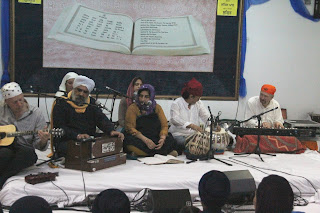

 "Even the much acclaimed Anuradha Paudwal was attracted to this assembly of artistes at the Gurdwara Sahib...."
On a sunny July, 2011, afternoon, my wife Harpal and I drove to a sleepy village near Stroud, Gloucestershire, England, to pick up youngest brother Dya Singh.
Over a “cup of tea” served in largish square mugs, his artiste host, Craig Pruess, invited me to sit next to him in his home music studio. It was the best position for sound reception as we listened to Dya Singh’s near-final version of Dukh Bhanjan Tera Nam, .a thematic recording of about 35 Gurbani Shabads. (Remarkably similar to those in Dukh Bhanjni Sahib!)
With one hand on the keyboard of an electronic device showing complex sound-wave patterns, Craig made recording adjustments. In-between, he also managed to tune his surmandal (Indian string instrument) to Gujri-Todi raag base. It was agreed that surmandal should be used in certain melodies. Dya Singh sat on a sofa at one end of the studio, listening meditatively and making the occasional comment.
I was witnessing the finishing touches to a Sikh world-music recording – Dya Singh version -by two world class artistes using the latest studio technology.
Dya Singh’s quest for distinctly Sikh world-music, which appeals to the universal music ear, continues. Meeting Craig Pruess and working with him has given a further musical dimension to this work in progress.
The opening quote from Gurinder Chadha is from the cover note of another CD recorded by Dya Singh, promoted by Gurinder, and produced by Craig in a series, Universal meditative chants from the Holy tradition of Nanak, or just Sacred Chants of the Sikhs. It also aptly describes Dya Singh’s journey and musical goal: to present Gurbani in world-music that “has the power to promote deep relaxation, meditation contemplation and devotion, regardless of religion and cultural back ground.” I have respect for Gurinder’s phenomenal success in film making, if not for her expertise in any field, especially in music! However, her interest in Dya Singh can only be beneficial in his musical quest.
Craig has acquired international reputation as a producer and “arranger” of music for almost all of Gurinder Chadha’s films since 1993 and also works for the likes of Sir Cliff Richard. He is an accomplished multi-instrumentalist equally versatile and creative with Eastern and Western musical traditions.
For the first time, Craig participated in Dya Singh group by playing the music synthesiser in the Sacred Sites component of the Manchester International Festival (MIF) from 6 to 10 July, 2011. It is with this background and Dya’s chance (or destined?) meeting with Craig, that I sense a next-step change in Dya’s quest for striking the right Sikh world-music chord.
After about 14 years, once again I am prompted to write about Dya Singh’s controversial presentation of Gurbani keertan (Sikh religious singing) in the context of Indian and Sikh musical traditions. These traditions are discussed at some length in a separate article, so that any criticism or praise of Dya Singh (the group) is at least on an informed basis.
I first wrote about Dya Singh in 1997, when Dr Jagir Singh of Chandigarh was visiting Australia for a wedding in the family. Following critical listening to Dya’s earliest CDs like Gurbani Yatra, Mystical Traveller, Australian Sikh Rhythm and Soul etc, the outcome was an article first published in Dr Jagir Singh’s Amrit Kirtan, and later reproduced by some other journals.
In August 2001, Dr I J Singh wrote an article about the controversy surrounding Dya Singh with an apt title, “Give the man a break”. Whilst, he supported Dya Singh's pioneering initiative to take Sikh music to mixed audiences worldwide by re-tuning it to the Western ear, his support was qualified. Like him, I too “come from a bias that likes to hear every shabd sung in the raag specified for it in the Guru Granth."
However, he lamented, " But that is so rarely heard even from the best-known traditional ragis.” Indeed, as mentioned in an article in “Amrat Kirtan” at the time, very few professional raagis have mastered more than about 4 raag ! Mostly they sing fixed tunes (bandash) in various raag without much originality, and pass these on to next generations. Of course, we have outstanding exceptions, and revered names like Bhai Samund Singh, Bhai Santa Singh, Bhai Avtar Singh, Bhai Dharam Singh Jakhmi and some contemporary classical raagis like Bhai Nirmal Singh, come to mind.
The article in hand is prompted by what I see as a next step in Dya Singh’s quest for peculiarly Sikh world-music capable of striking the right universal chord, and which, in Gurinder Chadha’s words “has the power to promote deep relaxation, meditation contemplation and devotion, regardless of religion and cultural back ground.” Maybe, as a musical maverick, Dya Singh would even say, regardless of the raag (shudh or misrat ie. pure or mixed) in which it is sung!
Increasingly, Dya Singh is on his own without much vocal support from his highly talented daughters. Also, he is mostly working with local musical talent wherever he goes. This change is exposing him to a greater variety of music - both Sikh and non-Sikh; Eastern and Western. Not surprisingly, and much against speculation, this change is for the better and brings him closer to his world-music goal.
Although, his middle daughter, Harsel, accompanied him and is at her personal best in the forthcoming CD, "Dukh Bhanjan Tera Naam", the melodies are decidedly more appealing to the global ear. Craig's fine tuning during the final stage would enhance that universal appeal.
Convergence of multi-faith music
Guru Nanak Sahib understood the great impact of Gurbani singing (keertan) on the human mind and the “transformational effect of the voice when raised in worship” (MIF web circular – see below). Thousands are spiritually touched by the young Sikh men and women of the Sukrit Trust singing Nitnem to the accompaniment of a variety of musical instruments on Sikh TV channels in the UK. When founders of this Trust nominated Dya Singh to represent Sikh faith music at the Manchester International Festival (MIF), one dryish comment was, “Well, did they have much of a choice?” It is true that few, if any, Sikh classical raagis have made it to world stages with the right music instrumental blends, and, in Gurinder Chadha’s words, “with resonant and captivating voice” like Dya Singh’s.
One part of the recent Manchester International Festival (MIF) from 6th to 10th July, 2011, was called Sacred Sites. To quote from the MIF Website, “Developed by MIF Creative in close collaboration with faith communities across Manchester, Sacred Sites invites those of any faith or none to experience the sublime power of the human voice in a series of special performances.” This was a low profile milestone achievement – a first - in the interfaith area, which brought together diverse religious musical traditions under the wider multicultural umbrella of an international festival. While there are attempts to bring world religions around one table in today’s dangerous world, there is also an increase in religious fanaticism. Low publicity for the event may have been intentional!
Sacred Sites programme brought together, “five of the foremost international performers of sacred song and recital for a week of extraordinary events in Christian, Hindu, Islamic, Jewish and Sikh sites of worship across the city.” Amongst these were, “Dya Singh (Shabads of Sikhism), Anuradha Paudwal (bhajans of Hinduism) and Qari Syed Sadaqat Ali (koran recital and Sufi poetry)” who enabled mixed congregations to experience “the sound and transformational effect of the voice when raised in worship.”
The Sikh “Sacred Site” was Gurdwara Sri Guru Harkrishan Sahib Ji where Dya Singh sang Gurbani Kirtan to the accompaniment of the traditional harmonium and tabla, and other string and electronic musical instruments played by world class maestros, also dedicated to the harmonisation of religious music. They, visibly, represented the musical version of the original “Parliament of World Religions,” which is Sri Guru Granth Sahib Ji. In addition to Craig on the music synthesiser, the more familiar faces were Dheeraj Shrestha (tabla) and Quentin Eyers (multi musical talent). Even the much acclaimed Anuradha Paudwal was attracted to this assembly of artistes at the Gurdwara Sahib in a special programme for children and young Sikhs.
Is Dya Singh and those in that ilk, doing something radical and revolutionary ? Or, are they simply continuing with music evolution – not unlike evolution of languages - over the centuries? In order to understand the trends in Indian and Sikh musical tradition we need to look back at the evolution in Indian and Sikh traditional music over the centuries. This is a topic for a separate article.
Bouquets and brickbats!
In Dya Singh’s view, Gurbani sangeet , as distinct from raag based Gurbani keertan by professional raagis, aims not so much to satisfy the technicalities, but more to provide a reasonably sound, practical and simplified approach to the learning and appreciation of Gurbani raag. Even classical music continues to evolve through exposure and through audience demand. Presentation of Gurbani sangeet by Dya Singh’s international music group is a part of this process. This effort does not compete with, but complements the great contribution to Sikh music by professional raagis. Yet, there have been instances when the latter show open resentment at Dya Singh’s popularity before mixed audiences.
The power of the heavenly message of Gurbani sung to the accompaniment of a variety of musical instruments touches every human soul. One view is that, following in the footsteps of Guru Nanak Sahib and Bhai Mardana, Sikhi should lead interfaith and world-music communication.
Dya Singh’s Sikh world-music adventure is controversial. It remains controversial with me, his eldest brother! I agree with Dr I J Singh when he writes, “Sometimes though, I think Dya Singh goes overboard......If a rendering of a hymn connects the listener to the infinite that is fine, if it does not then we need to recast the hymn in a different melody.”
Yet, it is noticeable to the discerning musical ear, that, over the years, his most severe critics have started imitating his style! That, perhaps, is the best compliment for his ongoing quest to capture the universal musical ear for disseminating the universal message of Gurbani. I do not appreciate some of his recordings and always revert to traditional raagis for prolonged periods, without listening to him. Recently when he was with me, I repeatedly played Bhai Balbir Singh’s 31 Raag to him in my personal mission to convert him back to traditional keertan! He listened to Raag Maru with some interest, only because I mentioned that it was almost lost to the Sikh musical tradition, which has also lost some popular folk dhunees due to neglect by raagi ghranas.
Dya Singh’s Gurbani keertan, liberally flavoured with world-music and sung in his powerful yet melodious voice is appreciatd by mixed world audiences. If it can provide one with “a silent and still oasis in the frenetic and busy world of ours” (Gurinder Chadha), then that should be welcome.
I am content to conclude with another quote from Dr I J Singh: “At the cutting edge of a more progressive and questioning approach to 20th Century ritual ridden Sikh institutions, Dya Singh continues happily to rouse strong emotions amongst traditional Sikhs.....God gave him a mellifluous voice and talent galore. So he performs keertan and gurbani sangeet as a mission.” (Dr I J Singh “Give the man a break”)
Gurmukh Singh
Ret’d Principal(policy), UK Civil Service
E-mail: sewauk2005@yahoo.co.uk
Copyright: Gurmukh Singh
This article may be published, or quoted from, with acknowledgement.
Please consult regarding any abbreviated or edited publication.
Photos by Satwinder Singh Matharu. These were taken during the Manchester International Festival, "Sacred Sites" programme 6 to 10 July, 2011. The Sikh "Sacred Site" was Sri Guru Harkrishan Sahib Ji Gurdwara.

Above: Dya Singh with renowned Indian singer, Anuradha Paudwal (on his right) with children at Sri Guru Har Krishan ji Gurdwara. Dheeraj Shrestha, Craig Pruess and Quentin Eyres are on his left.

From left: Quetin Eyres with guitar, Dya Singh, Anuradha Paudwal, Dheeraj Shrestha and Craig Pruess at Sri Guru Har Krishan Sahib ji Gurdwara, Manchester (UK).


Dya Singh’s Quest for Sikh World-Music
On a sunny July, 2011, afternoon, my wife Harpal and I drove to a sleepy village near Stroud, Gloucestershire, England, to pick up youngest brother Dya Singh.
Over a “cup of tea” served in largish square mugs, his artiste host, Craig Pruess, invited me to sit next to him in his home music studio. It was the best position for sound reception as we listened to Dya Singh’s near-final version of Dukh Bhanjan Tera Nam, .a thematic recording of about 35 Gurbani Shabads. (Remarkably similar to those in Dukh Bhanjni Sahib!)
With one hand on the keyboard of an electronic device showing complex sound-wave patterns, Craig made recording adjustments. In-between, he also managed to tune his surmandal (Indian string instrument) to Gujri-Todi raag base. It was agreed that surmandal should be used in certain melodies. Dya Singh sat on a sofa at one end of the studio, listening meditatively and making the occasional comment.
I was witnessing the finishing touches to a Sikh world-music recording – Dya Singh version -by two world class artistes using the latest studio technology.
Dya Singh’s quest for distinctly Sikh world-music, which appeals to the universal music ear, continues. Meeting Craig Pruess and working with him has given a further musical dimension to this work in progress.
The opening quote from Gurinder Chadha is from the cover note of another CD recorded by Dya Singh, promoted by Gurinder, and produced by Craig in a series, Universal meditative chants from the Holy tradition of Nanak, or just Sacred Chants of the Sikhs. It also aptly describes Dya Singh’s journey and musical goal: to present Gurbani in world-music that “has the power to promote deep relaxation, meditation contemplation and devotion, regardless of religion and cultural back ground.” I have respect for Gurinder’s phenomenal success in film making, if not for her expertise in any field, especially in music! However, her interest in Dya Singh can only be beneficial in his musical quest.
Craig has acquired international reputation as a producer and “arranger” of music for almost all of Gurinder Chadha’s films since 1993 and also works for the likes of Sir Cliff Richard. He is an accomplished multi-instrumentalist equally versatile and creative with Eastern and Western musical traditions.
For the first time, Craig participated in Dya Singh group by playing the music synthesiser in the Sacred Sites component of the Manchester International Festival (MIF) from 6 to 10 July, 2011. It is with this background and Dya’s chance (or destined?) meeting with Craig, that I sense a next-step change in Dya’s quest for striking the right Sikh world-music chord.
After about 14 years, once again I am prompted to write about Dya Singh’s controversial presentation of Gurbani keertan (Sikh religious singing) in the context of Indian and Sikh musical traditions. These traditions are discussed at some length in a separate article, so that any criticism or praise of Dya Singh (the group) is at least on an informed basis.
I first wrote about Dya Singh in 1997, when Dr Jagir Singh of Chandigarh was visiting Australia for a wedding in the family. Following critical listening to Dya’s earliest CDs like Gurbani Yatra, Mystical Traveller, Australian Sikh Rhythm and Soul etc, the outcome was an article first published in Dr Jagir Singh’s Amrit Kirtan, and later reproduced by some other journals.
In August 2001, Dr I J Singh wrote an article about the controversy surrounding Dya Singh with an apt title, “Give the man a break”. Whilst, he supported Dya Singh's pioneering initiative to take Sikh music to mixed audiences worldwide by re-tuning it to the Western ear, his support was qualified. Like him, I too “come from a bias that likes to hear every shabd sung in the raag specified for it in the Guru Granth."
However, he lamented, " But that is so rarely heard even from the best-known traditional ragis.” Indeed, as mentioned in an article in “Amrat Kirtan” at the time, very few professional raagis have mastered more than about 4 raag ! Mostly they sing fixed tunes (bandash) in various raag without much originality, and pass these on to next generations. Of course, we have outstanding exceptions, and revered names like Bhai Samund Singh, Bhai Santa Singh, Bhai Avtar Singh, Bhai Dharam Singh Jakhmi and some contemporary classical raagis like Bhai Nirmal Singh, come to mind.
The article in hand is prompted by what I see as a next step in Dya Singh’s quest for peculiarly Sikh world-music capable of striking the right universal chord, and which, in Gurinder Chadha’s words “has the power to promote deep relaxation, meditation contemplation and devotion, regardless of religion and cultural back ground.” Maybe, as a musical maverick, Dya Singh would even say, regardless of the raag (shudh or misrat ie. pure or mixed) in which it is sung!
Increasingly, Dya Singh is on his own without much vocal support from his highly talented daughters. Also, he is mostly working with local musical talent wherever he goes. This change is exposing him to a greater variety of music - both Sikh and non-Sikh; Eastern and Western. Not surprisingly, and much against speculation, this change is for the better and brings him closer to his world-music goal.
Although, his middle daughter, Harsel, accompanied him and is at her personal best in the forthcoming CD, "Dukh Bhanjan Tera Naam", the melodies are decidedly more appealing to the global ear. Craig's fine tuning during the final stage would enhance that universal appeal.
Convergence of multi-faith music
Guru Nanak Sahib understood the great impact of Gurbani singing (keertan) on the human mind and the “transformational effect of the voice when raised in worship” (MIF web circular – see below). Thousands are spiritually touched by the young Sikh men and women of the Sukrit Trust singing Nitnem to the accompaniment of a variety of musical instruments on Sikh TV channels in the UK. When founders of this Trust nominated Dya Singh to represent Sikh faith music at the Manchester International Festival (MIF), one dryish comment was, “Well, did they have much of a choice?” It is true that few, if any, Sikh classical raagis have made it to world stages with the right music instrumental blends, and, in Gurinder Chadha’s words, “with resonant and captivating voice” like Dya Singh’s.
One part of the recent Manchester International Festival (MIF) from 6th to 10th July, 2011, was called Sacred Sites. To quote from the MIF Website, “Developed by MIF Creative in close collaboration with faith communities across Manchester, Sacred Sites invites those of any faith or none to experience the sublime power of the human voice in a series of special performances.” This was a low profile milestone achievement – a first - in the interfaith area, which brought together diverse religious musical traditions under the wider multicultural umbrella of an international festival. While there are attempts to bring world religions around one table in today’s dangerous world, there is also an increase in religious fanaticism. Low publicity for the event may have been intentional!
Sacred Sites programme brought together, “five of the foremost international performers of sacred song and recital for a week of extraordinary events in Christian, Hindu, Islamic, Jewish and Sikh sites of worship across the city.” Amongst these were, “Dya Singh (Shabads of Sikhism), Anuradha Paudwal (bhajans of Hinduism) and Qari Syed Sadaqat Ali (koran recital and Sufi poetry)” who enabled mixed congregations to experience “the sound and transformational effect of the voice when raised in worship.”
The Sikh “Sacred Site” was Gurdwara Sri Guru Harkrishan Sahib Ji where Dya Singh sang Gurbani Kirtan to the accompaniment of the traditional harmonium and tabla, and other string and electronic musical instruments played by world class maestros, also dedicated to the harmonisation of religious music. They, visibly, represented the musical version of the original “Parliament of World Religions,” which is Sri Guru Granth Sahib Ji. In addition to Craig on the music synthesiser, the more familiar faces were Dheeraj Shrestha (tabla) and Quentin Eyers (multi musical talent). Even the much acclaimed Anuradha Paudwal was attracted to this assembly of artistes at the Gurdwara Sahib in a special programme for children and young Sikhs.
Is Dya Singh and those in that ilk, doing something radical and revolutionary ? Or, are they simply continuing with music evolution – not unlike evolution of languages - over the centuries? In order to understand the trends in Indian and Sikh musical tradition we need to look back at the evolution in Indian and Sikh traditional music over the centuries. This is a topic for a separate article.
Bouquets and brickbats!
In Dya Singh’s view, Gurbani sangeet , as distinct from raag based Gurbani keertan by professional raagis, aims not so much to satisfy the technicalities, but more to provide a reasonably sound, practical and simplified approach to the learning and appreciation of Gurbani raag. Even classical music continues to evolve through exposure and through audience demand. Presentation of Gurbani sangeet by Dya Singh’s international music group is a part of this process. This effort does not compete with, but complements the great contribution to Sikh music by professional raagis. Yet, there have been instances when the latter show open resentment at Dya Singh’s popularity before mixed audiences.
The power of the heavenly message of Gurbani sung to the accompaniment of a variety of musical instruments touches every human soul. One view is that, following in the footsteps of Guru Nanak Sahib and Bhai Mardana, Sikhi should lead interfaith and world-music communication.
Dya Singh’s Sikh world-music adventure is controversial. It remains controversial with me, his eldest brother! I agree with Dr I J Singh when he writes, “Sometimes though, I think Dya Singh goes overboard......If a rendering of a hymn connects the listener to the infinite that is fine, if it does not then we need to recast the hymn in a different melody.”
Yet, it is noticeable to the discerning musical ear, that, over the years, his most severe critics have started imitating his style! That, perhaps, is the best compliment for his ongoing quest to capture the universal musical ear for disseminating the universal message of Gurbani. I do not appreciate some of his recordings and always revert to traditional raagis for prolonged periods, without listening to him. Recently when he was with me, I repeatedly played Bhai Balbir Singh’s 31 Raag to him in my personal mission to convert him back to traditional keertan! He listened to Raag Maru with some interest, only because I mentioned that it was almost lost to the Sikh musical tradition, which has also lost some popular folk dhunees due to neglect by raagi ghranas.
Dya Singh’s Gurbani keertan, liberally flavoured with world-music and sung in his powerful yet melodious voice is appreciatd by mixed world audiences. If it can provide one with “a silent and still oasis in the frenetic and busy world of ours” (Gurinder Chadha), then that should be welcome.
I am content to conclude with another quote from Dr I J Singh: “At the cutting edge of a more progressive and questioning approach to 20th Century ritual ridden Sikh institutions, Dya Singh continues happily to rouse strong emotions amongst traditional Sikhs.....God gave him a mellifluous voice and talent galore. So he performs keertan and gurbani sangeet as a mission.” (Dr I J Singh “Give the man a break”)
Gurmukh Singh
Ret’d Principal(policy), UK Civil Service
E-mail: sewauk2005@yahoo.co.uk
Copyright: Gurmukh Singh
This article may be published, or quoted from, with acknowledgement.
Please consult regarding any abbreviated or edited publication.
Friday, 24 June 2011
First Anglo-Sikh War : Book Review
(Book review: Published in the June 2011 issue of "The Sikh Review" and some other journals.)
This is the first study of its type, which uses battlefield archaeology to give a vivid account of the battles fought during the First Anglo-Sikh War. The terrain and landmarks of each battlefield are described in detail “to give a comprehensive vision of the battlefield”. Satellite imagery on Google Earth has been used and there are many battlefield sketches and photographs.
This pioneering methodology also invites similar studies of other Indian battlefields. As Prof. Peter Doyle writes in his foreword to this excellent book by Amarpal Singh Sidhu, “Battlefield archaeology has grown out of a need to reinterpret battlefields, to place them in their correct geographic setting, to understand the events that were played out in past wars…”.
In addition to Indian sources, much new unpublished information, such as first hand accounts, maps and letters from that period over the last 100 years, has been included from UK sources such as the National Army Museum, British Library and a few other museums.
And so, the reader is given a tour of each battlefield as he retraces the clash between two great armies from 18 December 1845 to 10 February 1846. The stakes were high: loss of sovereignty for the Sikh state, or the end of colonial rule in India.
There are many well researched books written in recent years of the chaotic period after Maharaja Ranjit Singh’s death (27 June 1839) and the two Anglo-Sikh Wars ending in the annexation of Punjab by the British in 1849. However, my question, “Why yet another book?”, is answered by the author in his preface, “Appreciation of the battlefields is important. No other single event can decide the fate of countries and nations in more dramatic fashion than trial of strength over a few square kilometres of often uncompromising land. Few other events are more galling than the loss of independence suffered after a defeat. On the battlefield are displayed the highest human qualities of bravery, camaraderie, and loyalty and also the basest vices of treachery and cowardice.”
In many ways this remarkable book complements other earlier studies of this period. Of these, “The Last Sunset: Rise and Fall of the Lahore Darbar” by Capt. Amarinder Singh of Patiala reviewed by Dr Kirpal Singh in the December 2010 issue of The Sikh Review, is a more recent publication.
The author has done a most objective introductory analysis of the events which led to the First Anglo-Sikh War and the battles of Mudki, Ferozeshah, Bhudowal, Aliwal and the “slaugher” of the retreating Sikh army at Sabraon.
Clash between two great armies in India in the first half of the 19th century, was inevitable. The British colonial administrators and generals were waiting for the right opportunity but, for reasons discussed, they were in no hurry. “The pact of 1809 proved useful to the British because the powerful Sikh army was controlling the turbulent tribesmen in the north and west’ while “British rule was over the more placid states”. Therefore, “the Sikh empire provided security for the territories of the East India Company at no cost to the company itself.”
Meanwhile, the Sikh army of Maharaja Ranjit Singh’s kingdom, north of Sutlej River, was not quite ready to take on a well disciplined imperial force maintained entirely at the expense of the subdued rulers of India through the devise of “Subsidiary Alliance”. In addition, the British army had access to inexhaustible supply of Indian sepoys, whose loyalty was secured through the myth of the invincibility of the British. The British army was fully trained in superior western warfare methods and the generals had experience from other military campaigns and, no doubt, were full of “Victorian arrogance and bluster”. In fact, until Maharaja Ranjit Singh’s death, the waiting game was of mutual benefit to both sides.
The intrigue and treachery at Lahore Darbar following the death of Maharaja Ranjit Singh, and the subsequent loss of control over the Sikh soldiery, changed the “mutual benefit” equation. By 1945, the clash between British raj and Khalsa raj, which was inevitable, became imminent.
At some stage following years strife at Lahore after Maharaja Ranjit Singh, it was decided by Lahore administration that decimation of the recalcitrant Sikh army with British help, was the only solution. “Sikh Army had become a wholly republican force with generals having nominal control over the troops. It was the common soldiery that elected “punchayats” and therefore held ultimate power….they went on vendettas or carried out looting”, and absented themselves from cantonments without leave for long periods. Taxes could not be collected and the treasury was empty.
The British too were getting regular reports of the events at Lahore and continued to make necessary preparations.
In March 1945, Raja Gulab Singh of Kashmir (influential at Lahore) had already written to the British Governor General to invade Punjab. “This would not be a war of conquest, however, but one organised specifically to annihilate the recalcitrant Sikh army.”
This plan was communicated in advance to the British and full support offered by Gulab Singh, and in the battlefields, by Tej Singh Commander-in-Chief of the Sikh army and Lal Singh the Vizier or Prime Minister, who was second in command during this campaign. None of these three leading players on the Sikh side were Sikh or even Punjabi.
On the 11 December 1845, the Sikh army of 35 to 40 thousand crossed Sutlej with 150 guns. Although, the army remained in defensive positions and within Lahore territory south of Sutlej, this was nevertheless seen as an act of war by the British. Sir Henry Hardinge, the Governor-General, even after declaring war, had doubts about the legality, and rights and wrongs of the British campaign as he confided to his staff at Mudki, the site of the opening clash. It is significant that, despite provocation, the large Sikh army did not attack Ferozepore despite provocation, and adopted a defensive position at Ferozeshah.
The Sikh army was divided into four separate contingents (including the one at Philaur), and kept on the defensive as sitting targets to be attacked and overrun at will by the well disciplined and well led British forces at Mudki, Ferozeshah, and Sabraon. The engagements at Bhudowal and Aliwal under the command of an inefficient, and inexperienced Ranjodh Singh based at Philaur, were probably not part of this treacherous plot against the Sikh state. However, the disastrous retreat of the Sikh army across Sutlej River from Aliwal, was a forerunner to the contrived massacre on a much larger scale of the retreating Sikh force at Sabraon.
Throughout the War, British would be kept well informed about battle plans, deployment of forces, entrenchments and weaknesses in defences.
Strength and military formations of opposing forces, the battle itself, casualties and the aftermath, are based mostly on original records and eyewitness evidence pieced together painstakingly, cross-checked and corroborated where possible.
The book is in two parts: First part gives an account of each battle giving details as above and the second part gives battlefield guides and locations of places of interest on, and near, the battlefields.
And so each battle is brought to life. Soldiers on both sides showed incredible bravery. None asked for mercy and no mercy was shown.
Both, Sir Henry Hardinge, the Governor General of India, an experienced military man himself, and Sir Hugh Gough Commander-in-Chief, were present at the main battles of Mudki, Ferozeshah, and Sabraon.
Due to well planned attacks by the British force in full knowledge of Sikh defences and weak points, the battles themselves were quite short. Sabraon, the last battle, was around 4 hours, Aliwal around 2-3 hours, Bhudowal even less. Only Mudki and Ferozehshah lasted around 8-9 hours. It was mainly due to the Sikh commanders always keeping the Sikh army in a defensive position and not advancing during a British retreat that battles like Ferozeshah,Chillianwalla, Bhudowal ended prematurely.
Despite a much longer supply line, compared with the Sikh army, the British had better field intelligence and communication; their smaller numbers were deployed more efficiently, their battlefield tactics were better than the leaderless Sikh army, and they kept in battle formations and showed readiness to attack. The Sikh army remained divided and on the defensive and hardly used the cavalry. They kept waiting and allowed British forces to build up.
The author has shown how opportunities to destroy the British army were missed by the Sikh commanders. With better military intelligence, some highly vulnerable targets like Ludhiana and Ferozepore with small contingents, and the military supply train from Delhi, could have been destroyed almost at the outset of hostilities, and even the capture of Delhi was well within Sikh grasp. Loss of confidence in the British invincibility would have brought forward the 1857 Indian mutiny.
However, when Lahore Darbar itself was ready to surrender its sovereignty to the British, that was not to be.
The treachery of Tej Singh and Lal Singh claimed something like 10,000 lives at Sabraon where a single lane boat bridge had been partly destroyed by Lal Singh and Tej Singh “taking precaution to first retire across it themselves, their object being to effect, as far as possible, the annihilation of the feared and detested army.” (William Edwardes, Under Secretary to the British Government). As Gough and Hardinge watched the Sabraon battle from a watchtower at Rhodewalla village, Hardinge reminded a British officer, Thackwell, riding past, “When you get into the entrenchment, don’t spare them”.
The cavalry charge by Sardar Sham Singh Attariwala is described by eyewitnesses. Dressed in white, he mounted his horse “Shah Kabutar” and rallying 50 cavalrymen behind him he charged HM 50th Regiment on the British left. “He was later found riddled with seven shots. Hardinge later compared his attack to that of the Light Brigade, writing that “with Sham Singh fell the bravest of the Sikh generals.”
Gough’s pre-battle order not to spare any Sikh soldiers was carried out. “Now and then a few [Sikh soldiers] turned and rushed at us with their tulwars only to be caught on our bayonets or to be shot down. The slaughter was terrible.” (Pte Joseph Hewitt 62nd Foot p 162)
In this war, the British captured a total number of 320 guns of which 80 guns “had a bigger calibre than anything seen in Europe.”
This study is a milestone achievement for Sikh historiographers in the comparatively new discipline of battlefield archaeology. It gives much new material for military analysts, historiographers, serious students of Sikh history and lay readers and tourist interested in understanding the battles in the First Anglo-Sikh War.
The book is well written. Perhaps the author could have given modern spellings for the names of some villages and places mentioned in the book.
“The First Anglo-Sikh War”
Author: Amarpal Singh Sidhu
Foreword by Professor Peter Doyle, Battlefield Archaeologist.
Amberley Publishing Plc
http://www.amberleybooks.com/
Hardback 240 pages
It is available at many UK stores like W H Smith and can be ordered online on most major internet book websites e.g. Amazon (UK) & Amazon (.com)
Book review by Gurmukh Singh
sewauk2005@yahoo.co.uk
© Copyright Gurmukh Singh
Please acknowledge quotations from this article
Articles may be published subject to prior approval by the author
This is the first study of its type, which uses battlefield archaeology to give a vivid account of the battles fought during the First Anglo-Sikh War. The terrain and landmarks of each battlefield are described in detail “to give a comprehensive vision of the battlefield”. Satellite imagery on Google Earth has been used and there are many battlefield sketches and photographs.
This pioneering methodology also invites similar studies of other Indian battlefields. As Prof. Peter Doyle writes in his foreword to this excellent book by Amarpal Singh Sidhu, “Battlefield archaeology has grown out of a need to reinterpret battlefields, to place them in their correct geographic setting, to understand the events that were played out in past wars…”.
In addition to Indian sources, much new unpublished information, such as first hand accounts, maps and letters from that period over the last 100 years, has been included from UK sources such as the National Army Museum, British Library and a few other museums.
And so, the reader is given a tour of each battlefield as he retraces the clash between two great armies from 18 December 1845 to 10 February 1846. The stakes were high: loss of sovereignty for the Sikh state, or the end of colonial rule in India.
There are many well researched books written in recent years of the chaotic period after Maharaja Ranjit Singh’s death (27 June 1839) and the two Anglo-Sikh Wars ending in the annexation of Punjab by the British in 1849. However, my question, “Why yet another book?”, is answered by the author in his preface, “Appreciation of the battlefields is important. No other single event can decide the fate of countries and nations in more dramatic fashion than trial of strength over a few square kilometres of often uncompromising land. Few other events are more galling than the loss of independence suffered after a defeat. On the battlefield are displayed the highest human qualities of bravery, camaraderie, and loyalty and also the basest vices of treachery and cowardice.”
In many ways this remarkable book complements other earlier studies of this period. Of these, “The Last Sunset: Rise and Fall of the Lahore Darbar” by Capt. Amarinder Singh of Patiala reviewed by Dr Kirpal Singh in the December 2010 issue of The Sikh Review, is a more recent publication.
The author has done a most objective introductory analysis of the events which led to the First Anglo-Sikh War and the battles of Mudki, Ferozeshah, Bhudowal, Aliwal and the “slaugher” of the retreating Sikh army at Sabraon.
Clash between two great armies in India in the first half of the 19th century, was inevitable. The British colonial administrators and generals were waiting for the right opportunity but, for reasons discussed, they were in no hurry. “The pact of 1809 proved useful to the British because the powerful Sikh army was controlling the turbulent tribesmen in the north and west’ while “British rule was over the more placid states”. Therefore, “the Sikh empire provided security for the territories of the East India Company at no cost to the company itself.”
Meanwhile, the Sikh army of Maharaja Ranjit Singh’s kingdom, north of Sutlej River, was not quite ready to take on a well disciplined imperial force maintained entirely at the expense of the subdued rulers of India through the devise of “Subsidiary Alliance”. In addition, the British army had access to inexhaustible supply of Indian sepoys, whose loyalty was secured through the myth of the invincibility of the British. The British army was fully trained in superior western warfare methods and the generals had experience from other military campaigns and, no doubt, were full of “Victorian arrogance and bluster”. In fact, until Maharaja Ranjit Singh’s death, the waiting game was of mutual benefit to both sides.
The intrigue and treachery at Lahore Darbar following the death of Maharaja Ranjit Singh, and the subsequent loss of control over the Sikh soldiery, changed the “mutual benefit” equation. By 1945, the clash between British raj and Khalsa raj, which was inevitable, became imminent.
At some stage following years strife at Lahore after Maharaja Ranjit Singh, it was decided by Lahore administration that decimation of the recalcitrant Sikh army with British help, was the only solution. “Sikh Army had become a wholly republican force with generals having nominal control over the troops. It was the common soldiery that elected “punchayats” and therefore held ultimate power….they went on vendettas or carried out looting”, and absented themselves from cantonments without leave for long periods. Taxes could not be collected and the treasury was empty.
The British too were getting regular reports of the events at Lahore and continued to make necessary preparations.
In March 1945, Raja Gulab Singh of Kashmir (influential at Lahore) had already written to the British Governor General to invade Punjab. “This would not be a war of conquest, however, but one organised specifically to annihilate the recalcitrant Sikh army.”
This plan was communicated in advance to the British and full support offered by Gulab Singh, and in the battlefields, by Tej Singh Commander-in-Chief of the Sikh army and Lal Singh the Vizier or Prime Minister, who was second in command during this campaign. None of these three leading players on the Sikh side were Sikh or even Punjabi.
On the 11 December 1845, the Sikh army of 35 to 40 thousand crossed Sutlej with 150 guns. Although, the army remained in defensive positions and within Lahore territory south of Sutlej, this was nevertheless seen as an act of war by the British. Sir Henry Hardinge, the Governor-General, even after declaring war, had doubts about the legality, and rights and wrongs of the British campaign as he confided to his staff at Mudki, the site of the opening clash. It is significant that, despite provocation, the large Sikh army did not attack Ferozepore despite provocation, and adopted a defensive position at Ferozeshah.
The Sikh army was divided into four separate contingents (including the one at Philaur), and kept on the defensive as sitting targets to be attacked and overrun at will by the well disciplined and well led British forces at Mudki, Ferozeshah, and Sabraon. The engagements at Bhudowal and Aliwal under the command of an inefficient, and inexperienced Ranjodh Singh based at Philaur, were probably not part of this treacherous plot against the Sikh state. However, the disastrous retreat of the Sikh army across Sutlej River from Aliwal, was a forerunner to the contrived massacre on a much larger scale of the retreating Sikh force at Sabraon.
Throughout the War, British would be kept well informed about battle plans, deployment of forces, entrenchments and weaknesses in defences.
Strength and military formations of opposing forces, the battle itself, casualties and the aftermath, are based mostly on original records and eyewitness evidence pieced together painstakingly, cross-checked and corroborated where possible.
The book is in two parts: First part gives an account of each battle giving details as above and the second part gives battlefield guides and locations of places of interest on, and near, the battlefields.
And so each battle is brought to life. Soldiers on both sides showed incredible bravery. None asked for mercy and no mercy was shown.
Both, Sir Henry Hardinge, the Governor General of India, an experienced military man himself, and Sir Hugh Gough Commander-in-Chief, were present at the main battles of Mudki, Ferozeshah, and Sabraon.
Due to well planned attacks by the British force in full knowledge of Sikh defences and weak points, the battles themselves were quite short. Sabraon, the last battle, was around 4 hours, Aliwal around 2-3 hours, Bhudowal even less. Only Mudki and Ferozehshah lasted around 8-9 hours. It was mainly due to the Sikh commanders always keeping the Sikh army in a defensive position and not advancing during a British retreat that battles like Ferozeshah,Chillianwalla, Bhudowal ended prematurely.
Despite a much longer supply line, compared with the Sikh army, the British had better field intelligence and communication; their smaller numbers were deployed more efficiently, their battlefield tactics were better than the leaderless Sikh army, and they kept in battle formations and showed readiness to attack. The Sikh army remained divided and on the defensive and hardly used the cavalry. They kept waiting and allowed British forces to build up.
The author has shown how opportunities to destroy the British army were missed by the Sikh commanders. With better military intelligence, some highly vulnerable targets like Ludhiana and Ferozepore with small contingents, and the military supply train from Delhi, could have been destroyed almost at the outset of hostilities, and even the capture of Delhi was well within Sikh grasp. Loss of confidence in the British invincibility would have brought forward the 1857 Indian mutiny.
However, when Lahore Darbar itself was ready to surrender its sovereignty to the British, that was not to be.
The treachery of Tej Singh and Lal Singh claimed something like 10,000 lives at Sabraon where a single lane boat bridge had been partly destroyed by Lal Singh and Tej Singh “taking precaution to first retire across it themselves, their object being to effect, as far as possible, the annihilation of the feared and detested army.” (William Edwardes, Under Secretary to the British Government). As Gough and Hardinge watched the Sabraon battle from a watchtower at Rhodewalla village, Hardinge reminded a British officer, Thackwell, riding past, “When you get into the entrenchment, don’t spare them”.
The cavalry charge by Sardar Sham Singh Attariwala is described by eyewitnesses. Dressed in white, he mounted his horse “Shah Kabutar” and rallying 50 cavalrymen behind him he charged HM 50th Regiment on the British left. “He was later found riddled with seven shots. Hardinge later compared his attack to that of the Light Brigade, writing that “with Sham Singh fell the bravest of the Sikh generals.”
Gough’s pre-battle order not to spare any Sikh soldiers was carried out. “Now and then a few [Sikh soldiers] turned and rushed at us with their tulwars only to be caught on our bayonets or to be shot down. The slaughter was terrible.” (Pte Joseph Hewitt 62nd Foot p 162)
In this war, the British captured a total number of 320 guns of which 80 guns “had a bigger calibre than anything seen in Europe.”
This study is a milestone achievement for Sikh historiographers in the comparatively new discipline of battlefield archaeology. It gives much new material for military analysts, historiographers, serious students of Sikh history and lay readers and tourist interested in understanding the battles in the First Anglo-Sikh War.
The book is well written. Perhaps the author could have given modern spellings for the names of some villages and places mentioned in the book.
“The First Anglo-Sikh War”
Author: Amarpal Singh Sidhu
Foreword by Professor Peter Doyle, Battlefield Archaeologist.
Amberley Publishing Plc
http://www.amberleybooks.com/
Hardback 240 pages
It is available at many UK stores like W H Smith and can be ordered online on most major internet book websites e.g. Amazon (UK) & Amazon (.com)
Book review by Gurmukh Singh
sewauk2005@yahoo.co.uk
© Copyright Gurmukh Singh
Please acknowledge quotations from this article
Articles may be published subject to prior approval by the author
Saturday, 2 April 2011
Gurdwara 21st Century, Adelaide, South Australia
Mission & Vision of a Neurosurgeon
Adelaide is called the City of Churches. The gurdwara, located at the main entrance to the city from the west, on the highway from Melbourne, has visibly added to the diversity of places of worship in this, one of the most beautiful and well planned, cities in the world.
An interesting feature of this gurdwara is that the sangat hall rests on a massive rock reminding one of Dhaol dharam – the bull of dharma in Japji Sahib. It is an old heritage listed building built (1846) within 10 years of the founding of Adelaide City in 1836.
 |
| Splendour of Darbar Hall..................... |

supported by the Rock of "Dhaol Dharam" !
Re-location of Adelaide’s first Gurdwara to this heritage site a few years ago, realised the vision of a Sikh neurosurgeon, Dr Swaran Singh Khera, of a 21st century gurdwara complete with modern facilities. Some of these are shown in the pictures below:

Gurdwara viewed from the main car park
From left: Baldev Singh JP, Giani Kuldip Singh, Dr Swaran Singh and Dya Singh)

Seminar hall which can also be used as second Langar hall.

Langar hall (Yes ! With chairs; but there is also facility for Pangat on floor at one end.)

Panjabi School with modern facilities (Giani Kuldip Singh with author Gurmukh Singh)

Panjabi School (Photo 2)
From left: Giani Kuldip Singh, Gurmukh Singh, Dya Singh and Dr Swaran Singh

Panjabi School (photo 3)

Above and below: Modern spotless kitchen

Below: Unlike most Gurdwaras, Giani ji "Babay da Vazir" is not forgotten !

Giani ji's double, well decorated, bedroom.

A large kitchen area with computer working facility and a spare bed.

Clean spacious bathroom (I insisted on this photo being taken!)

Giani ji's Sangat counselling room. (Adjoining is a general facilities room.)
Dr Khera may not be a religious missionary but his concern is for the image of the Sikh community of Adelaide - not the religious aspects of Sikhism - his knowledge of which, at his own admission, is limited. Nevertheless, that does not stop him from locking horns with "orthodox" grey beards including myself. "Why have a golak in front of the Guru Granth Sahib ?" he argues, "Are we paying respects to the money in the golak or are we paying our respects to the Guru? The passage to the Guru should not be cluttered with golaks, unnecessary flowers, pictures of our 'gurus' and swords and other weapons etc." One may not agree with him on all aspects of his common sense approach, but he is a robust social activist in the true Sikhi spirit of chardhi kalla.
As a "Sikh Centre", the gurdwara caters for the spiritual and socio-cultural needs of the local Sikh community, while remaining warmly open to all. Programmes in the gurdwara service are planned in advance and punctuality is enforced. The youngish Gurdwara Giani, Kuldip Singh, is required to prepare a pointed bilingual English/ Punjabi service every Sunday with multimedia aids and supported by students of Gurbani. Elderly retired teacher, Master Joginder Singh (ex-Malaysia), gave initial Gurbani guidance now continued by volunteers like retired teacher Ajmer Singh Randhava, lawyer Bahal Singh and others including some ladies.
All sangat participate in singing Shabads in melodious spirituality, a tradition introduced by Dya Singh of Australia, one of the founders of the gurdwara. Dr Harbans Singh Gill accompanies Bhai Kuldip Singh – a proficient Kirtania-kathakar – on the harmonium. My namesake, Gurmukh Singh, a dedicated sevadar, senior motor mechanic and car racing enthusiast, is roped in as spare tabla player. There are other youngish Gursikh Kirtanias and Paatthis. The sound system for kirtan was specially commissioned. Observed Dya Singh, “Kirtan must sound good - not sound like an intercom system on a railway platform!” Inspired by those like Bibi Balbir Kaur (gurdwara secretary, and wife of recent Hind Ratan awardee, Dr Bhagwant Singh), women lead by doing dedicated seva.
Gurdwara presidents, like the current incumbent, Balwant Singh, serve in turn. The team spirit and seva bhavna of all is most remarkable and refreshing. Nevertheless, my own observation is that the gurdwara is mainly run by well educated ladies. I wonder what the anti-Bibian-di-seva jathedars at Darbar Sahib would say about that!
Quite significantly, this “modern” gurdwara is located at a cross roads junction which reminds one of where Sikhi tradition stands today! It is a typical example of the trend in the Sikh diaspora to seek own local solutions to the current and future spiritual and socio-cultural needs. This is one consequence of the loss of credibility in the office holders at the central Sikh institutions of the Shromani Gurdwara Parbandhak Committee (SGPC) and Akal Takh Sahib. Due to frequent controversies, lack of consistent direction on important Sikh issues and regression of Sikhi to bipran (Brahmanic) ritualism, and take-over bids by derawadi kattar-panthis or just ambitious individuals even in these remote places, many Gurdwaras feel no longer bound to seek central direction. In the process they sometimes end up locking horns with the traditional elements regarding, for example, chairs and tables in the langgar hall; proper excess for wheelchair devotees and chairs in the main hall at the back for those unable to sit cross-legged in the sangat hall.
Where this decentralisation of interpretation of Gurmat and Sikh reht maryada would lead the global Sikhs, remains to be seen.
Dr Khera may not be a religious missionary but his concern is for the image of the Sikh community of Adelaide - not the religious aspects of Sikhism - his knowledge of which, at his own admission, is limited. Nevertheless, that does not stop him from locking horns with "orthodox" grey beards including myself. "Why have a golak in front of the Guru Granth Sahib ?" he argues, "Are we paying respects to the money in the golak or are we paying our respects to the Guru? The passage to the Guru should not be cluttered with golaks, unnecessary flowers, pictures of our 'gurus' and swords and other weapons etc." One may not agree with him on all aspects of his common sense approach, but he is a robust social activist in the true Sikhi spirit of chardhi kalla.
As a "Sikh Centre", the gurdwara caters for the spiritual and socio-cultural needs of the local Sikh community, while remaining warmly open to all. Programmes in the gurdwara service are planned in advance and punctuality is enforced. The youngish Gurdwara Giani, Kuldip Singh, is required to prepare a pointed bilingual English/ Punjabi service every Sunday with multimedia aids and supported by students of Gurbani. Elderly retired teacher, Master Joginder Singh (ex-Malaysia), gave initial Gurbani guidance now continued by volunteers like retired teacher Ajmer Singh Randhava, lawyer Bahal Singh and others including some ladies.
All sangat participate in singing Shabads in melodious spirituality, a tradition introduced by Dya Singh of Australia, one of the founders of the gurdwara. Dr Harbans Singh Gill accompanies Bhai Kuldip Singh – a proficient Kirtania-kathakar – on the harmonium. My namesake, Gurmukh Singh, a dedicated sevadar, senior motor mechanic and car racing enthusiast, is roped in as spare tabla player. There are other youngish Gursikh Kirtanias and Paatthis. The sound system for kirtan was specially commissioned. Observed Dya Singh, “Kirtan must sound good - not sound like an intercom system on a railway platform!” Inspired by those like Bibi Balbir Kaur (gurdwara secretary, and wife of recent Hind Ratan awardee, Dr Bhagwant Singh), women lead by doing dedicated seva.
Gurdwara presidents, like the current incumbent, Balwant Singh, serve in turn. The team spirit and seva bhavna of all is most remarkable and refreshing. Nevertheless, my own observation is that the gurdwara is mainly run by well educated ladies. I wonder what the anti-Bibian-di-seva jathedars at Darbar Sahib would say about that!
Quite significantly, this “modern” gurdwara is located at a cross roads junction which reminds one of where Sikhi tradition stands today! It is a typical example of the trend in the Sikh diaspora to seek own local solutions to the current and future spiritual and socio-cultural needs. This is one consequence of the loss of credibility in the office holders at the central Sikh institutions of the Shromani Gurdwara Parbandhak Committee (SGPC) and Akal Takh Sahib. Due to frequent controversies, lack of consistent direction on important Sikh issues and regression of Sikhi to bipran (Brahmanic) ritualism, and take-over bids by derawadi kattar-panthis or just ambitious individuals even in these remote places, many Gurdwaras feel no longer bound to seek central direction. In the process they sometimes end up locking horns with the traditional elements regarding, for example, chairs and tables in the langgar hall; proper excess for wheelchair devotees and chairs in the main hall at the back for those unable to sit cross-legged in the sangat hall.
Where this decentralisation of interpretation of Gurmat and Sikh reht maryada would lead the global Sikhs, remains to be seen.

(Photos by S. Baldev Singh JP; ex-Councillor Riverlnd, South Australia)
Gurmukh Singh
© Gurmukh Singh
Articles in this blogspot may be quoted or reproduced with acknowledgement.
Thursday, 3 February 2011
CELEBRATION & HOPE: Sikh Sacred Music
1Gurmukh Singh (UK) & 2I.J. Singh (USA)
Christians and Hindus are way ahead of us. Christians have boys choral ensembles, mixed choirs, women gospel singers, and accomplished instrumentalists. Church history even speaks of castrati gospel singers that we wouldn’t want. Much of Indian classical music, too, owes its development to the early Hindu worship service – a close association that is no longer apparent. Male cantors have dominated Judaism and its services. Muslims never allowed or mixed music in their religion until the emergence of Sufis.
Much of Western classical music – instrumental and vocal -- owes its development to the patronage of the Church. Mostly men but some excellent women’s voices as well have enriched our lives by religious music. The American Black Christian community has produced the most scintillating and electrifying women gospel singers. Here we are thinking of Mahalia Jackson, Shirley Murdock, Shirley Caesar and Vickie Winans, among others.
In the realm of sacred music Sikhism is highly unusual, if not unique. Its entire scripture (Guru Granth), with a few minor exceptions, is set to the language and idiom of classical Indian musicology. The Guru-Founders were superb poets and musicians and recognized that music can transcend words.
One would think that the grammar and technology of music are only vehicles to carry the meaning of the words and their message, but when the Gurus married divine poetry to heavenly music they created a whole that remains greater than the sum of the parts.
Naturally then central to a Sikh service is the Guru Granth and the celebration revolves around keertan – the singing of the liturgy. History tells us even non-Sikh reputable Indian singers would often visit gurdwaras not because of any great love for Sikhi but to learn and pick some pointers on esoteric intricacies of classical Indian vocal music.
But Sikhs, too, are not immune to rash and immature decisions: one is the illogical ban on women performing keertan in the Harmander Sahib (Golden Temple). The hierarchy made a one-time exception when in the 1970’s women converts to Sikhism were allowed to sing at the Harmander but never again.
This flicker of common sense died; the religious hierarchy responded to the inevitable protest by promising hearings and quick action in the matter. But time is a very different animal in the Indian socio-cultural reality and almost 40 years later we still await the return of sense and reason. It remains an ill-considered ban that continues to defy commonsense.
Yet, some of us have always been seeking out women who were exponents of keertan. There have always been individual women, like Surinder Kaur or Jaspreet Kaur Narula, who also sang hymns from the Guru Granth but not all that many and not with the same single-minded commitment to either gurbani or to the cause of spanning the gender divide.
Then a couple of years ago we heard of this India (Ludhiana) based group of women who were singing gurbani in raaga. Their recordings were not easy to find and they were not on the radar for most of us. But to find one of their recordings became a pleasure – somewhat like a successful treasure hunt.
Now these women – the Gurmat Gian Group of the Gurmat Gian Missionary College, have produced a set of six CD’s with hymns from the Guru Granth in each of the 31 raagas; each hymn rendered in the shudh (pure) raaga specified in the Guru Granth.
We admire their attitude that they summarize thus: To sing gurbani in raaga is not the same thing as to sing raaga in gurbaani.” We agree entirely.
Gurbani affirms the importance of meditative singing to attain a state of spiritual bliss: "Heaven is where Your praises are sung" (Tahan baikunt jeh kirtan Tera, Guru Granth p 749)
Listening to these renderings by this gifted group is truly a spiritual experience. Their highlighting of keertan in raagas successfully establishes classical Kirtan as a religio-cultural heritage of both Sikh women and men. This is a most notable achievement.
The Shabad sung to melodious classical notes led by Gurpreet Kaur reminds the listener of the line in Anand Sahib that speaks of angelic, musical families coming together to sing the Guru’s Word” (Raag ratan parwaar parian Sabad gavan aaya(n), Guru Granth p 917).
The Divine Word is experienced as musical “dhun” or celestial melody, whereby the human soul comprehends the incomprehensible. The “Akath Kahani”, becomes more meaningful. The mind is attuned [to God through celestial music], and in meditation, by the Guru’s grace, the unutterable story (ultimate Reality) comprehended. (Dhun meh dhian dhian meh jaanya Gurmukh akath kahani; (Guru Granth p 879)
what one of us (GS) wrote earlier about keertan by this group remains equally relevant today: “The spirituality and depth of Ardaas is felt in shabads like “Hey Sansaar Taap Harnay” (Guru Granth p 1358) ,that, like so many other shabads by the Group, brings out the musical miracle of four angelic voices in perfect harmony, individual renditions and changes in taal (beat) between jhap (10 beats), teentaal (16 beats) and ektaal (yakka of 12 beats) – all rendered effortlessly..…….And so on, each and every shabad is the Guru’s Message delivered directly to the Kirtan rassia’s inner being.”
Heaven is where Your praises are sung.
Raagas are mood inducing melodies which also relate to times of the day and seasons. Productions like “Raag Ratan” stressing the classical raaga in which each shabad appears in Guru Granth, enhance the impact of experience and understanding. The Guru's Word, Gurbani, in Guru Granth, the Sikh Holy Scripture, is in verse. The Word was delivered by the Sikh Gurus, as received from God: "As I receive the Word of the Lord; So I express it, O Lalo" says Guru Nanak (GGS p 722).
The received Word was in meditative verse. Gurbani keertan is an "experience" of the Word. The realization comes with repeated experience through Gurbani keertan., Dr. Balbinder Singh Bhogal, a scholar of Sikhi, reminds us: "Indeed, part of the lure of the poetic form is that it eludes total comprehension and is enriched by ever new interpretations. The poem does not provide an answer to life's mysteries, but reveals its wonders. The poem by its very form is not limited to a singular meaning, so it does not offer an answer with the confidence of an ego-centric bark. Instead it entices the ego to unravel its mystery, and in the process unravels itself. The poetic structure is inherently contemplative and unsettling - it refuses to be tamed into singular plain speech of prose philosophy."
Therefore, the musical aspect is stressed in Guru Granth Sahib and the name of the “raaga” specified for each composition. The melody creates the environment and mental state for focussed reception of the Word. Singing the praises of the Creator in sangat (holy congregation) then takes precedence above all else. One is able to sing with and listen to others, and by sharing that experience, is able to contemplate and realize the Word within oneself. By repetitiveness of this personal and congregational experience, the ego-centric focus is replaced by humility and wondrous love and awe for the Creator. This altered attitude (by the Guru’s Grace) would then reflect in the behaviour and daily life of a Sikh, which stresses humility and meditation on the Creator in a life of a householder in the service of the Creator and creation. The Ultimate Reality cannot be captured in words alone.
Raagas induce moods corresponding to time-divisions of the day; to seasons or occasions etc. There are many rhythms, beats and rhymes. These reflect the wide spectrum of classical and popular musical traditions of the Indian sub-continent and contiguous areas. With minor exceptions, Gurbani is meant to be sung for maximum impact of its intrinsic message.
Gurmat Gian Group “Raag Ratan” experience
Starting with Sri Raag – the first of the 31 raagas in the Guru Granth - Gurpreet Kaur, the composer and singer, accompanied by her daughter Keerat Kaur lead the Keertan “rassia” (meditative listener) on a spiritual journey. Music accompaniment is under the direction of Sonu Khanna, with Sandeep Singh on Dilruba, Guiness world record tabla player, Paramjot Singh, and Jaganpreet Singh on tabla and pakhawaj (types of Indian drums). Introduction to the Shabad by Gurmat Gian Missionary College Principal, Rana Inderjit Singh, is concise and simple Panjabi.
The pattern for singing Shabads is similar. However, traditional delivery of raaga, starting with prolonged “alaap” and very slow beat, followed by increase in tempo to a climactic fast beat, is not followed – and that is a blessing for the average ear. Instead, after the introductory raaga base (“mukh ang”) played on dilruba or sung vocally, the listener is held spellbound by intricate vocal variations and “taal” (beat) changes.
To quote Dr Manbir Singh, “One of the features of this collection is that Shabads are sung in many uncommon Taals like Jhumra, Matta, Rudra, Sool, Panch Savari, Champ Savan, Dhamar, Jai Taal, Araha Char taal, Firodast along with routine taals.” Indeed, the effortless beat changes (“parhtaals”) become almost imperceptible. (Being conversant with main taals only, we personally used finger count of beats (matra, taali/khaal etc) to track taal changes.
The immensely popular Raag Maajh is the vehicle for: “Sun sun jeeva soe Tumaari..” It is rendered as a duet by Gurpreet Kaur and her daughter Keerat Kaur. The spiritual journey in “dhun” continues through the raag. “Har Samrath ki sarna” (Guru Granth p 987) in raag Maali Gaura is mesmezing in its meditative appeal and raag-taal technical complexity. As Manbir Singh tells us, “Maali Gaura is in Dhamar Taal (14 beats) - Dhamar Shaiylee. Indeed, technically the most challenging; this Shabad took the most time to record…..None of the team had performed this earlier in this taal and shaiylee.” And on full display are Gurpreet Kaur’s enviable depth and range in meditative raag based singing and total command of sur and taal.
Naturally, one tends to tune in on one’s own favourites such as Maajh, Malhar, Basant, Kanra, Kalyan, Jaijavanti, Jaitsri, Nut-Narayan etc more often. The increasing dependence on the harmonium and pop rhythms by even notable raagees has possibly been the bane of good Keertan in recent years. Hence we take note of the revival of singing with string instruments (“taanti saaj”) as in “Raag Ratan”. Because of the infinite “shruti” (divisions of the “naad” or notes), a vocalist of Indian classical tradition has more possibilities of expression since he can play subtle fractions of notes – this option remains extremely limited in Western vocal or instrumental traditions.
Comment on this classical music art collection from a strictly technical aspect is beyond our pale. However, as avid listeners we felt sometimes that the shabad could have been concluded sooner by avoiding some technical tabla fireworks towards the end. As a “gandharab” raagi Sant Sarwan Singh recommends in his writings on Gurbani Kirtan, tabla should enhance the shabad singing and pyrotechnical displays restricted to solo performances. This minor caveat aside, Paramjot Singh and Jaganpreet Singh have excelled at a most gentle and musical “kinaar” while playing deep sounding pakhawaj (“mridang” type of beats) where needed.
As Gyani Jarnail Singh of Malaysia tells us, “This is exactly the way Ilahi (divine) Gurbani should be sung, in perfect taal, sur …....I congratulate these soul-brides of our Beloved Guru.....”.
The women of the Gurmat Gian Group may not be in the same class as maestros like Bhai Samund Singh; Dharam Singh Zakhmi, his brother Shamsher Singh and son Amrik Singh Zakhmi; Avtar Singh; Dillbag Singh-Gulbagh Singh; Baljit Singh (Namdhari); Balbir Singh and Nirmal Singh or Singh Bandhu, and other legendary singers of gurbani, but they are breaking fresh ground. These women are a breath of fresh air.
“Raag Ratan” is truly a historic and, for Sikh women, an exemplary accomplishment by the Gurmat Gian Group. It is a unique gift for listeners of classical Gurbani Sangeet. It is the first production of its type by Sikh women.
The Gurmat Gian Group can be accessed on their website (http://gurmatgiangroup.wordpress.com/ )
1sewauk2005@yahoo.co.uk
2ijsingh99@gmail.com
February 2, 2011
(Note: This article may be published with acknowledgement of joint authorship.)
Christians and Hindus are way ahead of us. Christians have boys choral ensembles, mixed choirs, women gospel singers, and accomplished instrumentalists. Church history even speaks of castrati gospel singers that we wouldn’t want. Much of Indian classical music, too, owes its development to the early Hindu worship service – a close association that is no longer apparent. Male cantors have dominated Judaism and its services. Muslims never allowed or mixed music in their religion until the emergence of Sufis.
Much of Western classical music – instrumental and vocal -- owes its development to the patronage of the Church. Mostly men but some excellent women’s voices as well have enriched our lives by religious music. The American Black Christian community has produced the most scintillating and electrifying women gospel singers. Here we are thinking of Mahalia Jackson, Shirley Murdock, Shirley Caesar and Vickie Winans, among others.
In the realm of sacred music Sikhism is highly unusual, if not unique. Its entire scripture (Guru Granth), with a few minor exceptions, is set to the language and idiom of classical Indian musicology. The Guru-Founders were superb poets and musicians and recognized that music can transcend words.
One would think that the grammar and technology of music are only vehicles to carry the meaning of the words and their message, but when the Gurus married divine poetry to heavenly music they created a whole that remains greater than the sum of the parts.
Naturally then central to a Sikh service is the Guru Granth and the celebration revolves around keertan – the singing of the liturgy. History tells us even non-Sikh reputable Indian singers would often visit gurdwaras not because of any great love for Sikhi but to learn and pick some pointers on esoteric intricacies of classical Indian vocal music.
But Sikhs, too, are not immune to rash and immature decisions: one is the illogical ban on women performing keertan in the Harmander Sahib (Golden Temple). The hierarchy made a one-time exception when in the 1970’s women converts to Sikhism were allowed to sing at the Harmander but never again.
This flicker of common sense died; the religious hierarchy responded to the inevitable protest by promising hearings and quick action in the matter. But time is a very different animal in the Indian socio-cultural reality and almost 40 years later we still await the return of sense and reason. It remains an ill-considered ban that continues to defy commonsense.
Yet, some of us have always been seeking out women who were exponents of keertan. There have always been individual women, like Surinder Kaur or Jaspreet Kaur Narula, who also sang hymns from the Guru Granth but not all that many and not with the same single-minded commitment to either gurbani or to the cause of spanning the gender divide.
Then a couple of years ago we heard of this India (Ludhiana) based group of women who were singing gurbani in raaga. Their recordings were not easy to find and they were not on the radar for most of us. But to find one of their recordings became a pleasure – somewhat like a successful treasure hunt.
Now these women – the Gurmat Gian Group of the Gurmat Gian Missionary College, have produced a set of six CD’s with hymns from the Guru Granth in each of the 31 raagas; each hymn rendered in the shudh (pure) raaga specified in the Guru Granth.
We admire their attitude that they summarize thus: To sing gurbani in raaga is not the same thing as to sing raaga in gurbaani.” We agree entirely.
Gurbani affirms the importance of meditative singing to attain a state of spiritual bliss: "Heaven is where Your praises are sung" (Tahan baikunt jeh kirtan Tera, Guru Granth p 749)
Listening to these renderings by this gifted group is truly a spiritual experience. Their highlighting of keertan in raagas successfully establishes classical Kirtan as a religio-cultural heritage of both Sikh women and men. This is a most notable achievement.
The Shabad sung to melodious classical notes led by Gurpreet Kaur reminds the listener of the line in Anand Sahib that speaks of angelic, musical families coming together to sing the Guru’s Word” (Raag ratan parwaar parian Sabad gavan aaya(n), Guru Granth p 917).
The Divine Word is experienced as musical “dhun” or celestial melody, whereby the human soul comprehends the incomprehensible. The “Akath Kahani”, becomes more meaningful. The mind is attuned [to God through celestial music], and in meditation, by the Guru’s grace, the unutterable story (ultimate Reality) comprehended. (Dhun meh dhian dhian meh jaanya Gurmukh akath kahani; (Guru Granth p 879)
what one of us (GS) wrote earlier about keertan by this group remains equally relevant today: “The spirituality and depth of Ardaas is felt in shabads like “Hey Sansaar Taap Harnay” (Guru Granth p 1358) ,that, like so many other shabads by the Group, brings out the musical miracle of four angelic voices in perfect harmony, individual renditions and changes in taal (beat) between jhap (10 beats), teentaal (16 beats) and ektaal (yakka of 12 beats) – all rendered effortlessly..…….And so on, each and every shabad is the Guru’s Message delivered directly to the Kirtan rassia’s inner being.”
Heaven is where Your praises are sung.
Raagas are mood inducing melodies which also relate to times of the day and seasons. Productions like “Raag Ratan” stressing the classical raaga in which each shabad appears in Guru Granth, enhance the impact of experience and understanding. The Guru's Word, Gurbani, in Guru Granth, the Sikh Holy Scripture, is in verse. The Word was delivered by the Sikh Gurus, as received from God: "As I receive the Word of the Lord; So I express it, O Lalo" says Guru Nanak (GGS p 722).
The received Word was in meditative verse. Gurbani keertan is an "experience" of the Word. The realization comes with repeated experience through Gurbani keertan., Dr. Balbinder Singh Bhogal, a scholar of Sikhi, reminds us: "Indeed, part of the lure of the poetic form is that it eludes total comprehension and is enriched by ever new interpretations. The poem does not provide an answer to life's mysteries, but reveals its wonders. The poem by its very form is not limited to a singular meaning, so it does not offer an answer with the confidence of an ego-centric bark. Instead it entices the ego to unravel its mystery, and in the process unravels itself. The poetic structure is inherently contemplative and unsettling - it refuses to be tamed into singular plain speech of prose philosophy."
Therefore, the musical aspect is stressed in Guru Granth Sahib and the name of the “raaga” specified for each composition. The melody creates the environment and mental state for focussed reception of the Word. Singing the praises of the Creator in sangat (holy congregation) then takes precedence above all else. One is able to sing with and listen to others, and by sharing that experience, is able to contemplate and realize the Word within oneself. By repetitiveness of this personal and congregational experience, the ego-centric focus is replaced by humility and wondrous love and awe for the Creator. This altered attitude (by the Guru’s Grace) would then reflect in the behaviour and daily life of a Sikh, which stresses humility and meditation on the Creator in a life of a householder in the service of the Creator and creation. The Ultimate Reality cannot be captured in words alone.
Raagas induce moods corresponding to time-divisions of the day; to seasons or occasions etc. There are many rhythms, beats and rhymes. These reflect the wide spectrum of classical and popular musical traditions of the Indian sub-continent and contiguous areas. With minor exceptions, Gurbani is meant to be sung for maximum impact of its intrinsic message.
Gurmat Gian Group “Raag Ratan” experience
Starting with Sri Raag – the first of the 31 raagas in the Guru Granth - Gurpreet Kaur, the composer and singer, accompanied by her daughter Keerat Kaur lead the Keertan “rassia” (meditative listener) on a spiritual journey. Music accompaniment is under the direction of Sonu Khanna, with Sandeep Singh on Dilruba, Guiness world record tabla player, Paramjot Singh, and Jaganpreet Singh on tabla and pakhawaj (types of Indian drums). Introduction to the Shabad by Gurmat Gian Missionary College Principal, Rana Inderjit Singh, is concise and simple Panjabi.
The pattern for singing Shabads is similar. However, traditional delivery of raaga, starting with prolonged “alaap” and very slow beat, followed by increase in tempo to a climactic fast beat, is not followed – and that is a blessing for the average ear. Instead, after the introductory raaga base (“mukh ang”) played on dilruba or sung vocally, the listener is held spellbound by intricate vocal variations and “taal” (beat) changes.
To quote Dr Manbir Singh, “One of the features of this collection is that Shabads are sung in many uncommon Taals like Jhumra, Matta, Rudra, Sool, Panch Savari, Champ Savan, Dhamar, Jai Taal, Araha Char taal, Firodast along with routine taals.” Indeed, the effortless beat changes (“parhtaals”) become almost imperceptible. (Being conversant with main taals only, we personally used finger count of beats (matra, taali/khaal etc) to track taal changes.
The immensely popular Raag Maajh is the vehicle for: “Sun sun jeeva soe Tumaari..” It is rendered as a duet by Gurpreet Kaur and her daughter Keerat Kaur. The spiritual journey in “dhun” continues through the raag. “Har Samrath ki sarna” (Guru Granth p 987) in raag Maali Gaura is mesmezing in its meditative appeal and raag-taal technical complexity. As Manbir Singh tells us, “Maali Gaura is in Dhamar Taal (14 beats) - Dhamar Shaiylee. Indeed, technically the most challenging; this Shabad took the most time to record…..None of the team had performed this earlier in this taal and shaiylee.” And on full display are Gurpreet Kaur’s enviable depth and range in meditative raag based singing and total command of sur and taal.
Naturally, one tends to tune in on one’s own favourites such as Maajh, Malhar, Basant, Kanra, Kalyan, Jaijavanti, Jaitsri, Nut-Narayan etc more often. The increasing dependence on the harmonium and pop rhythms by even notable raagees has possibly been the bane of good Keertan in recent years. Hence we take note of the revival of singing with string instruments (“taanti saaj”) as in “Raag Ratan”. Because of the infinite “shruti” (divisions of the “naad” or notes), a vocalist of Indian classical tradition has more possibilities of expression since he can play subtle fractions of notes – this option remains extremely limited in Western vocal or instrumental traditions.
Comment on this classical music art collection from a strictly technical aspect is beyond our pale. However, as avid listeners we felt sometimes that the shabad could have been concluded sooner by avoiding some technical tabla fireworks towards the end. As a “gandharab” raagi Sant Sarwan Singh recommends in his writings on Gurbani Kirtan, tabla should enhance the shabad singing and pyrotechnical displays restricted to solo performances. This minor caveat aside, Paramjot Singh and Jaganpreet Singh have excelled at a most gentle and musical “kinaar” while playing deep sounding pakhawaj (“mridang” type of beats) where needed.
As Gyani Jarnail Singh of Malaysia tells us, “This is exactly the way Ilahi (divine) Gurbani should be sung, in perfect taal, sur …....I congratulate these soul-brides of our Beloved Guru.....”.
The women of the Gurmat Gian Group may not be in the same class as maestros like Bhai Samund Singh; Dharam Singh Zakhmi, his brother Shamsher Singh and son Amrik Singh Zakhmi; Avtar Singh; Dillbag Singh-Gulbagh Singh; Baljit Singh (Namdhari); Balbir Singh and Nirmal Singh or Singh Bandhu, and other legendary singers of gurbani, but they are breaking fresh ground. These women are a breath of fresh air.
“Raag Ratan” is truly a historic and, for Sikh women, an exemplary accomplishment by the Gurmat Gian Group. It is a unique gift for listeners of classical Gurbani Sangeet. It is the first production of its type by Sikh women.
The Gurmat Gian Group can be accessed on their website (http://gurmatgiangroup.wordpress.com/ )
1sewauk2005@yahoo.co.uk
2ijsingh99@gmail.com
February 2, 2011
(Note: This article may be published with acknowledgement of joint authorship.)
Friday, 21 January 2011
."Nanak Lama": Gurdwara Patthar Sahib, Leh, Ladakh
Historical Gurdwara Patthar Sahib is located about 25 KM from Leh in the Ladakh region of Jammu and Kashmir. It was flooded by over 5 feet of water following the cloud burst (very heavy and sudden rain) on 5 Ausgust 2010.

View from top of hill. According to local Budhists, a demon rolled down a large rock on Guru Nanak Sahib from this hill.
This Gurdwara Sahib, built and maintained by the Indian army, is historical and the background is that during his second journey (1515 to 1518) Guru Nanak Sahib stayed here in 1517 on return from Sumer Mountain. He travelled along the route from Nepal, Sikkim, Tibet and Yarkand to Leh and after discourses with local Budhists, came to be revered as Nanak Lama.
S. Baldev Singh Dhaliwal JP, South Australia, and I visited this Gurdwara Sahib on 22 September 2010, after travelling by road to Leh via Manali in Himachal Pardesh. We crossed passes over 13,000 feet. Heights of some passes:-. Rohtang Pass near Manali 13,044 feet, Baralacha La 16,042 feet, Lachlungla La 16,613 feet, Taklang La 17,582 feet (second highest pass in the world). The road over Khardung La pass beyond Leh at 18,380 feet, is the highest in the world.

Story of Gurdwara Patthar Sahib in English.

Sacred rock with imprint of Guru Nanak Sahib's head and back.

Sacred rock can be seen in the background from the Darbar Hall
(The author discussing history of Guru Nanak Sahib's visit to Leh, Ladakh)
(The author discussing history of Guru Nanak Sahib's visit to Leh, Ladakh)

Nishan Sahib on hilltop from which the demon threw the rock.
(Army jawans with S. Baldev Singh JP, Australia, and the author)

History of Gurdwara Patthar Sahib in Gurmukhi.

Army jawans doing seva at Tapp Asthaan on a rise behind the main Gurdwara.

Army stone plaques in Langar Hall. There are dozens of such plaques on the walls of the hall.
This was a most memorable and challenging trip for younger brother Baldev Singh of Australia and me. Our youngest brother, Dya Singh of Australia, was unable to join us this time.
E-mail: sewauk2005@yahoo.co.uk
Copyright: Gurmukh Singh
Material, including photos, may be used with acknowledgement.
Wednesday, 12 January 2011
OLD SIKH CHALLENGES IN THE NEW YEAR
With the arrival of the New Year, we also bring forward outstanding Sikh issues and concerns. This is the time to reflect whether, as a community, we have resolved some issues and made any progress on others.
As the Sikh community becomes more global, living in small remote communities at distant places, Sikh organisation (“jathebandi”) and central institutions are weakening. The latter have no clear strategy, no effective communication nor control mechanisms. Those holding high religious offices in Punjab are political stooges, incapable of interpreting Sikh ideology in the context of 21st Century issues and needs.
Challenges to Sikh identity and ideology e.g. the global challenge to Sikh turban, and the Sikh national Nanakshahi Calendar issue (which has now become a bit of a sad joke about shifting Gurpurab dates), spread of bogus deras and gurudoms, are just some of the many running sores to which there is no effective central response.
Regarding challenges to Sikh identity, in the absence of any timely advice or high profile action e.g. by lobbying governments and the United Nations, Sikhs have lost out on most fronts. Self-promoting individuals have taken over Sikh “representation”. Sikhs are still waiting to be counted as a distinct community in the UK. The current opposition behind the scenes by individuals to disrupt the working of the Sikh Council UK is another example of why we are failing in our corporate approach as a community.
Let me digress slightly before returning to the main theme. I write from South Australia after attending Guru Gobind Singh ji’s Parkaash Gupurab at the nearest and oldest Gurdwara in Adelaide. I compare the current Sikh position to that of over 20 years ago in this city. Then there were a few professional Sikhs, mainly from Malaysia, who held religious functions at one small Gurdwara. Now there are three gurdwaras run along different “maryadas”, and centred around certain groups or individuals. The old Gurdwara was moved to a new much larger site but is still run by the same core influential and affluent group. The Gurdwara remains user-friendly for non-Sikhs, and the management team takes interest in the image of the local Sikh community, but seem to have little interest in wider Australian or global Sikh affairs. To some extent, the same position is adopted by gurdwara managements in Sikh diaspora countries.
I mention the above because it is easier to study a smallish remote Sikh community like that of Adelaide, in order to understand wider global Sikh problems.
Therefore, while our central institutions are weakening and remain out-dated regarding their method of operation, the Sikh community is becoming more widespread. The need for global Sikh direction and unity through effective means of modern communication has been ignored for many years. One negative consequence is the total decentralisation of interpretation of Gurbani and Sikh personal and corporate “rehat” (i.e. way of life).
Panthic aims to promote Sikh corporate objectives and identity have come to a standstill. The milestone achievement of the House of Lords decision in the Mandla case, effectively recognised the Sikhs as a distinct people with own religion and socio-cultural tradition, identity and needs. Due to internal opposition by some, this legal recognition of Sikhs was not translated into the monitoring of the Sikhs as a distinct community in the UK, to be able to influence UK government policy in areas of equal opportunity, delivery of services and rights. Earlier efforts at national level unity have been frustrated by individual ambitions and factional divisions. The recent formation of the umbrella body, the Sikh Council UK, is a ray of hope in the New Year.
Sikh thinking needs to be guided by Gurbani as interpreted by Khalsa Panth. With the mushrooming of sant deras and bogus gurudoms, and the loss of the institution of Akal Takht Sahib to outside political interference, the process of interpreting Gurbani has been decentralised and is creating yet more divisions due to different “reht maryadas” (codes), encouraging bogus sant deras with spiritual heads and ritualism.
We have seen how the achievement of the Sikh national Nanakshahi Calendar as a global Sikh need, has been frustrated by the very institutions of SGPC and Akal Takht Sahib, which should have been promoting Sikh theo-political nationhood worldwide. These institutions are leaning towards “Bipran” (Brahmanic) practices when they should have been preaching and promoting one Sikh Reht Maryada and the Guru Granth-Guru Panth tradition.
An important UK achievement, which deserves wider publicity is the issue of guidelines relating to Sikh identity (kakaars and turban) which have been issued by the Equality and Human Rights Commission (EHRC) towards the end of last year. Many nationwide Sikh organisatons contributed in an exemplary manner to produce these guidelines.
As mentioned above, one consequence of the weakening of the institution of Akal Takht Sahib is that Sikhs in the diaspora have to increasingly rely on own centres for Gurbani research and interpretation through cyber networks. Let us hope that this would be a blessing in disguise to bring remote global Sikh communities together.
I conclude this articles with a positive musical note!
As and when I find time in my nomadic life, I listen to "Raag Ratan", a set of recently released 31 sudh raags in Guru Granth Sahib, sung truly in the Anand mode of "Raag ratan parwar paryia(n) Sabad gavan aayia(n)", by bibia(n) of the Gurmat Gian Group of Gurmat Gian Missionary College, Ludhiana. This is a trend setting exemplary achievment by mother daughter jatha of Bibi Gurpreet Kaur and Bibi Keerat Kaur for Sikh ladies in the diaspora.
I have yet to find time to "review" this great gift to the nation using my limited knowledge of classical raags. Nevertheless, this is a promise to Dr Manbir Singh, the Group motivator, which I shall keep.
Gurmukh Singh
Sewauk2005@yahoo.co.uk
As the Sikh community becomes more global, living in small remote communities at distant places, Sikh organisation (“jathebandi”) and central institutions are weakening. The latter have no clear strategy, no effective communication nor control mechanisms. Those holding high religious offices in Punjab are political stooges, incapable of interpreting Sikh ideology in the context of 21st Century issues and needs.
Challenges to Sikh identity and ideology e.g. the global challenge to Sikh turban, and the Sikh national Nanakshahi Calendar issue (which has now become a bit of a sad joke about shifting Gurpurab dates), spread of bogus deras and gurudoms, are just some of the many running sores to which there is no effective central response.
Regarding challenges to Sikh identity, in the absence of any timely advice or high profile action e.g. by lobbying governments and the United Nations, Sikhs have lost out on most fronts. Self-promoting individuals have taken over Sikh “representation”. Sikhs are still waiting to be counted as a distinct community in the UK. The current opposition behind the scenes by individuals to disrupt the working of the Sikh Council UK is another example of why we are failing in our corporate approach as a community.
Let me digress slightly before returning to the main theme. I write from South Australia after attending Guru Gobind Singh ji’s Parkaash Gupurab at the nearest and oldest Gurdwara in Adelaide. I compare the current Sikh position to that of over 20 years ago in this city. Then there were a few professional Sikhs, mainly from Malaysia, who held religious functions at one small Gurdwara. Now there are three gurdwaras run along different “maryadas”, and centred around certain groups or individuals. The old Gurdwara was moved to a new much larger site but is still run by the same core influential and affluent group. The Gurdwara remains user-friendly for non-Sikhs, and the management team takes interest in the image of the local Sikh community, but seem to have little interest in wider Australian or global Sikh affairs. To some extent, the same position is adopted by gurdwara managements in Sikh diaspora countries.
I mention the above because it is easier to study a smallish remote Sikh community like that of Adelaide, in order to understand wider global Sikh problems.
Therefore, while our central institutions are weakening and remain out-dated regarding their method of operation, the Sikh community is becoming more widespread. The need for global Sikh direction and unity through effective means of modern communication has been ignored for many years. One negative consequence is the total decentralisation of interpretation of Gurbani and Sikh personal and corporate “rehat” (i.e. way of life).
Panthic aims to promote Sikh corporate objectives and identity have come to a standstill. The milestone achievement of the House of Lords decision in the Mandla case, effectively recognised the Sikhs as a distinct people with own religion and socio-cultural tradition, identity and needs. Due to internal opposition by some, this legal recognition of Sikhs was not translated into the monitoring of the Sikhs as a distinct community in the UK, to be able to influence UK government policy in areas of equal opportunity, delivery of services and rights. Earlier efforts at national level unity have been frustrated by individual ambitions and factional divisions. The recent formation of the umbrella body, the Sikh Council UK, is a ray of hope in the New Year.
Sikh thinking needs to be guided by Gurbani as interpreted by Khalsa Panth. With the mushrooming of sant deras and bogus gurudoms, and the loss of the institution of Akal Takht Sahib to outside political interference, the process of interpreting Gurbani has been decentralised and is creating yet more divisions due to different “reht maryadas” (codes), encouraging bogus sant deras with spiritual heads and ritualism.
We have seen how the achievement of the Sikh national Nanakshahi Calendar as a global Sikh need, has been frustrated by the very institutions of SGPC and Akal Takht Sahib, which should have been promoting Sikh theo-political nationhood worldwide. These institutions are leaning towards “Bipran” (Brahmanic) practices when they should have been preaching and promoting one Sikh Reht Maryada and the Guru Granth-Guru Panth tradition.
An important UK achievement, which deserves wider publicity is the issue of guidelines relating to Sikh identity (kakaars and turban) which have been issued by the Equality and Human Rights Commission (EHRC) towards the end of last year. Many nationwide Sikh organisatons contributed in an exemplary manner to produce these guidelines.
As mentioned above, one consequence of the weakening of the institution of Akal Takht Sahib is that Sikhs in the diaspora have to increasingly rely on own centres for Gurbani research and interpretation through cyber networks. Let us hope that this would be a blessing in disguise to bring remote global Sikh communities together.
I conclude this articles with a positive musical note!
As and when I find time in my nomadic life, I listen to "Raag Ratan", a set of recently released 31 sudh raags in Guru Granth Sahib, sung truly in the Anand mode of "Raag ratan parwar paryia(n) Sabad gavan aayia(n)", by bibia(n) of the Gurmat Gian Group of Gurmat Gian Missionary College, Ludhiana. This is a trend setting exemplary achievment by mother daughter jatha of Bibi Gurpreet Kaur and Bibi Keerat Kaur for Sikh ladies in the diaspora.
I have yet to find time to "review" this great gift to the nation using my limited knowledge of classical raags. Nevertheless, this is a promise to Dr Manbir Singh, the Group motivator, which I shall keep.
Gurmukh Singh
Sewauk2005@yahoo.co.uk
Subscribe to:
Posts (Atom)